


HULL NUMBER |
|

|
|
UNIT AWARDS |
|

|
|
DATA |
|
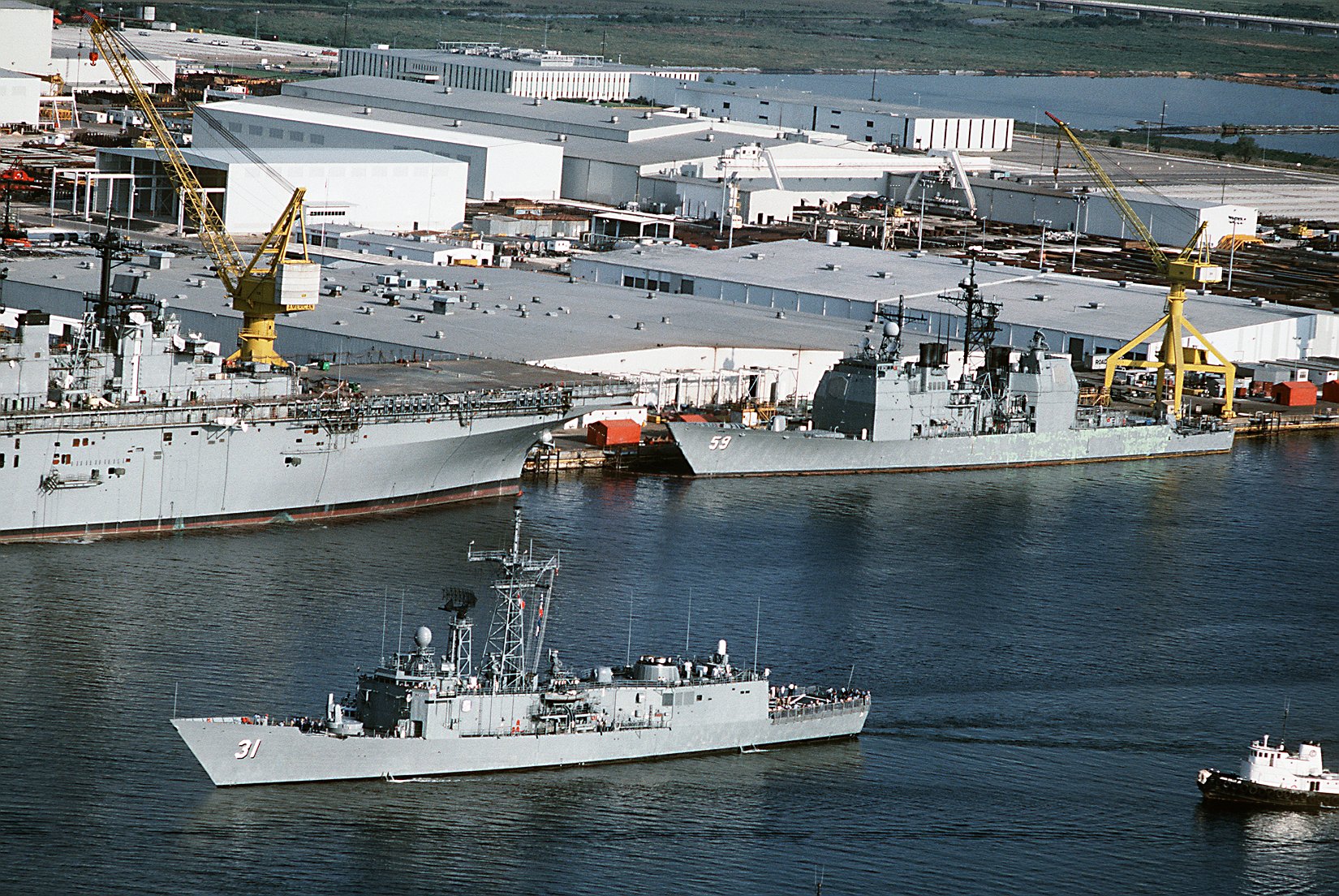
| Class: | Oliver Hazard Perry |
| Awarded: | 23 January 1978 |
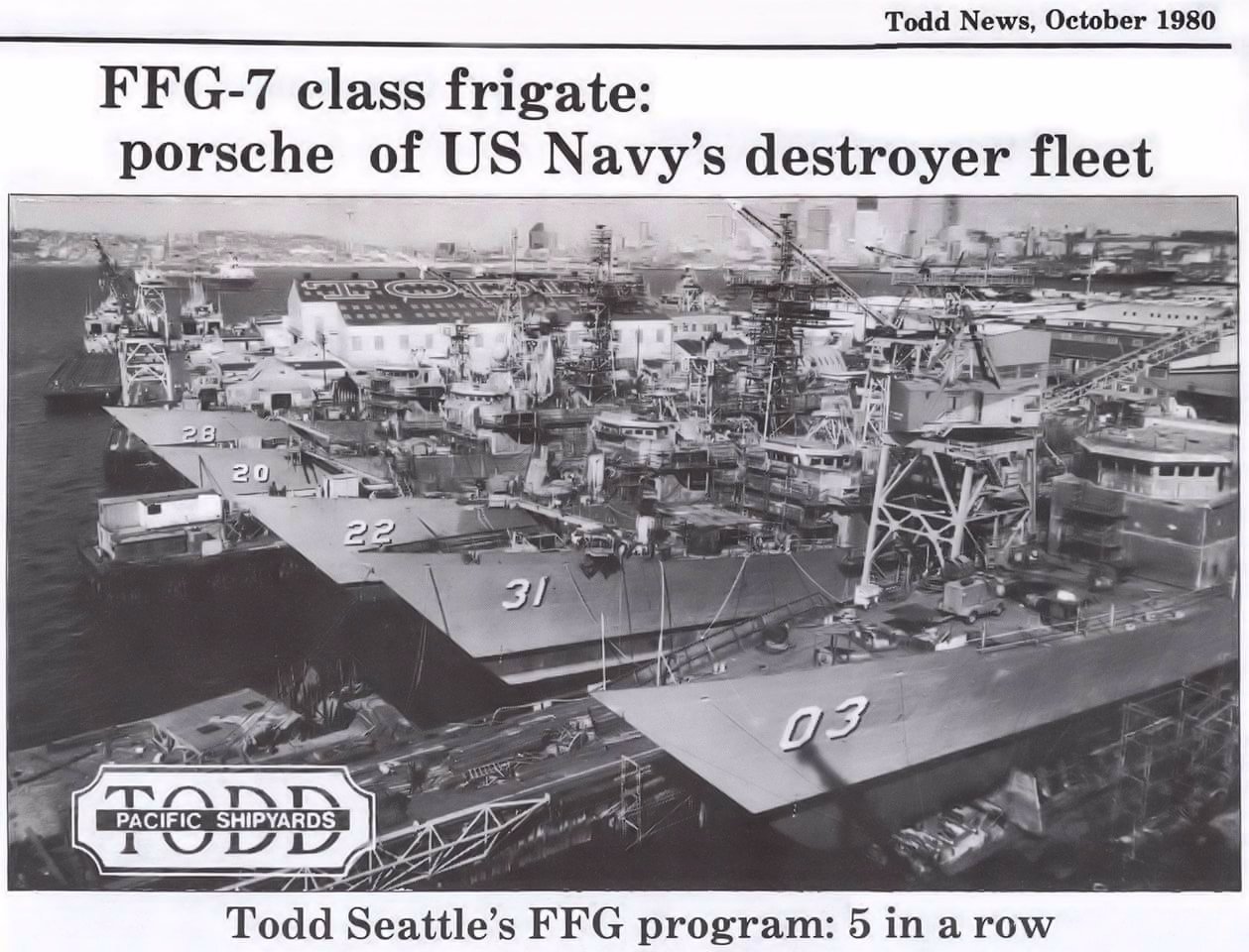
| Builder: | Todd Pacific Shipyards |
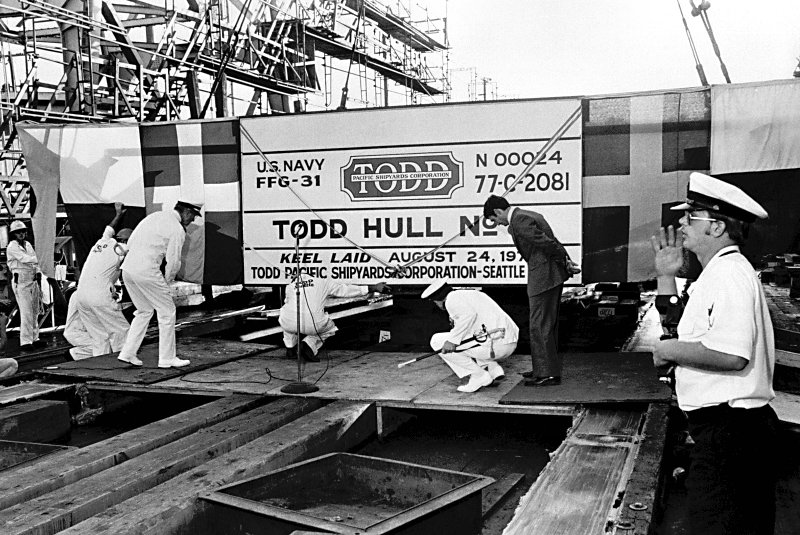
| Keel Laid: | 24 August 1979 |
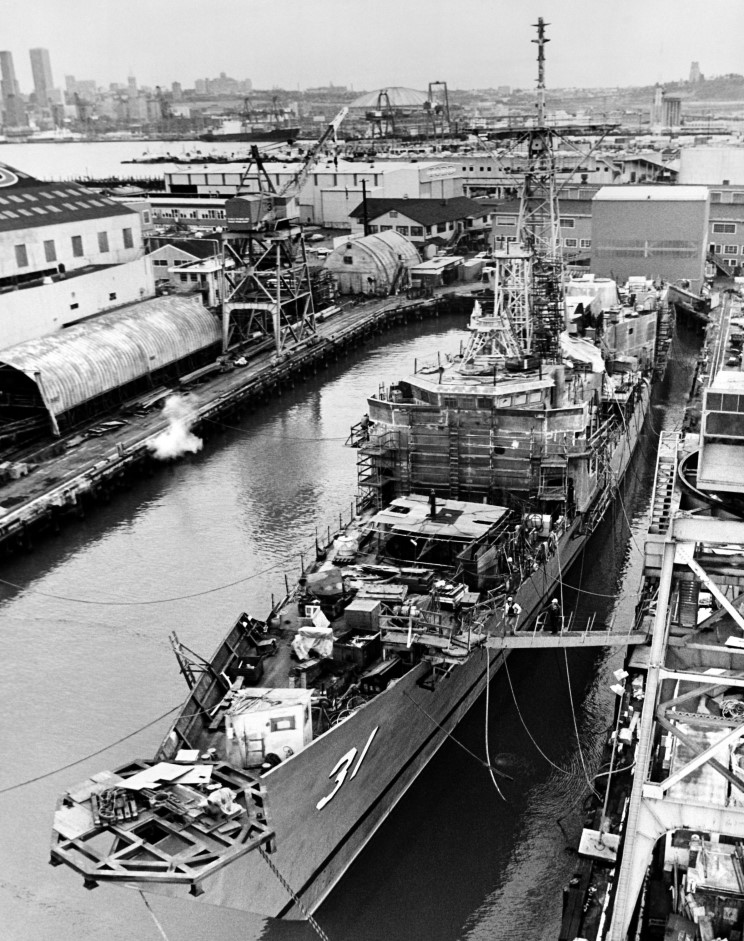
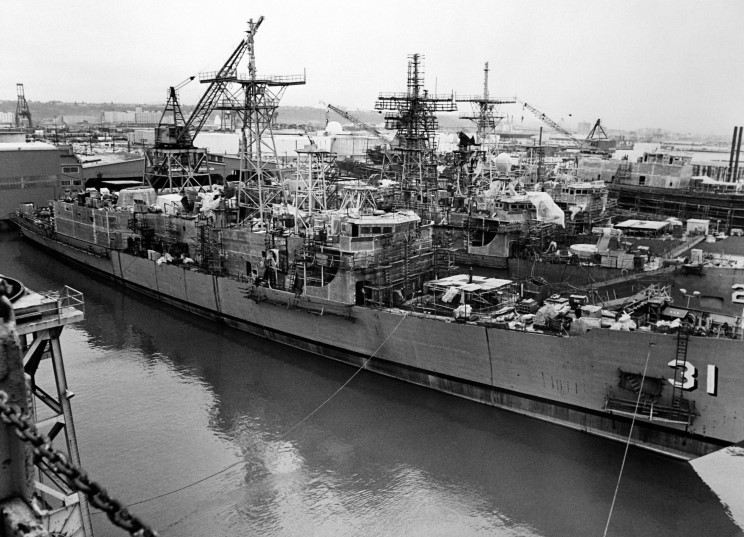
| Launched: | 30 May 1980 |
| Commissioned: | 23 October 1982 |
| Decommissioned: | 7 May 1999 |
| Stricken: | 7 May 1999 |
| Homeport: | Naval Station Mayport |
| Identification: | FFG-31 |
| Code Letters: | NHPA |
| Motto: | Strength for Freedom |
| Scrapped: | 2006 |
SPECIFICATIONS |
|
| Displacement: | 4100 tons |
| Length: | 445 feet |
| Beam: | 45 feet |
| Draft: | 22 feet |
| PROPULSION | 2 General Electric LM2500 gas turbines |
| 2 Auxiliary Propulsion Units, 350 hp retractable electric azimuth thrusters for maneuvering and docking | |
| SHP: | 41,000 |
| Speed: | 29 knots |
| Range: | 5,000 nm @ 18 knots |
| Complement: | 15 officers and 190 enlisted, plus SH-60 LAMPS detachment of roughly six officer pilots and 15 enlisted maintainers |
| Sensors &Processing Systems: | AN/SPS-49 air-search radar |
| AN/SPS-55 surface-search radar | |
| CAS and STIR fire-control radar | |
| AN/SQS-56 sonar | |
| Electronic warfare &decoys: | AN/SLQ-32 |
ARMAMENT |
|
| Guns | 1 OTO Melara Mk 75 76 mm/62 caliber naval gun |
| 1 Vulcan Phalanx CIWS | |
| 4 .50-cal (12.7 mm) machine guns | |
| Missiles | 1 Mk 13 Mod 4 single-arm launcher for Harpoon anti-ship missiles and SM-1MR Standard anti-ship/air missiles (40 round magazine) |
| Torpedoes | 2 Mk 32 triple-tube (324 mm) launchers for Mark 46 torpedoes |
AIRCRAFT |
|
| Helicopter: | 1 SH-2F LAMPS I |
| CDR Terrence W. Costello III | 23OCT82 - 29JAN85 |
| CAPT Glenn Richard Brindel | 29JAN85 - 23JUN87 |
| CDR John Byard Noll | 23JUN87 - 29JMAY90 |
| CDR Henry George Ulrich III | 29MAY90 - 20MAR92 |
| CDR Peter Wynkoop, Jr. † | 20MAR92 - 25FEB94 |
| CDR Richard Crittendon Rush | 25FEB94 - 19JAN96 |
| CDR Michael Raymond Johnston | 19JAN96 - 10AUG97 |
| CDR Orrin Wayne Young | 10AUG97 - 07MAY99 |
|
|
|
|
|
|
|
|
|
|
|
|
|
|
|
|
|
|
|
|
|
|
|
|
|
|
|
|
|
|
|
|
|
|
|
|
|
|
|
|
|
|
|
|
|

|
|
|
|
|
|
|
|

|

|
|
|
|
|
|
|
|
|
|
|
|
|
|
|
|
|
|
|
|
×
|
|
COMMISSIONING
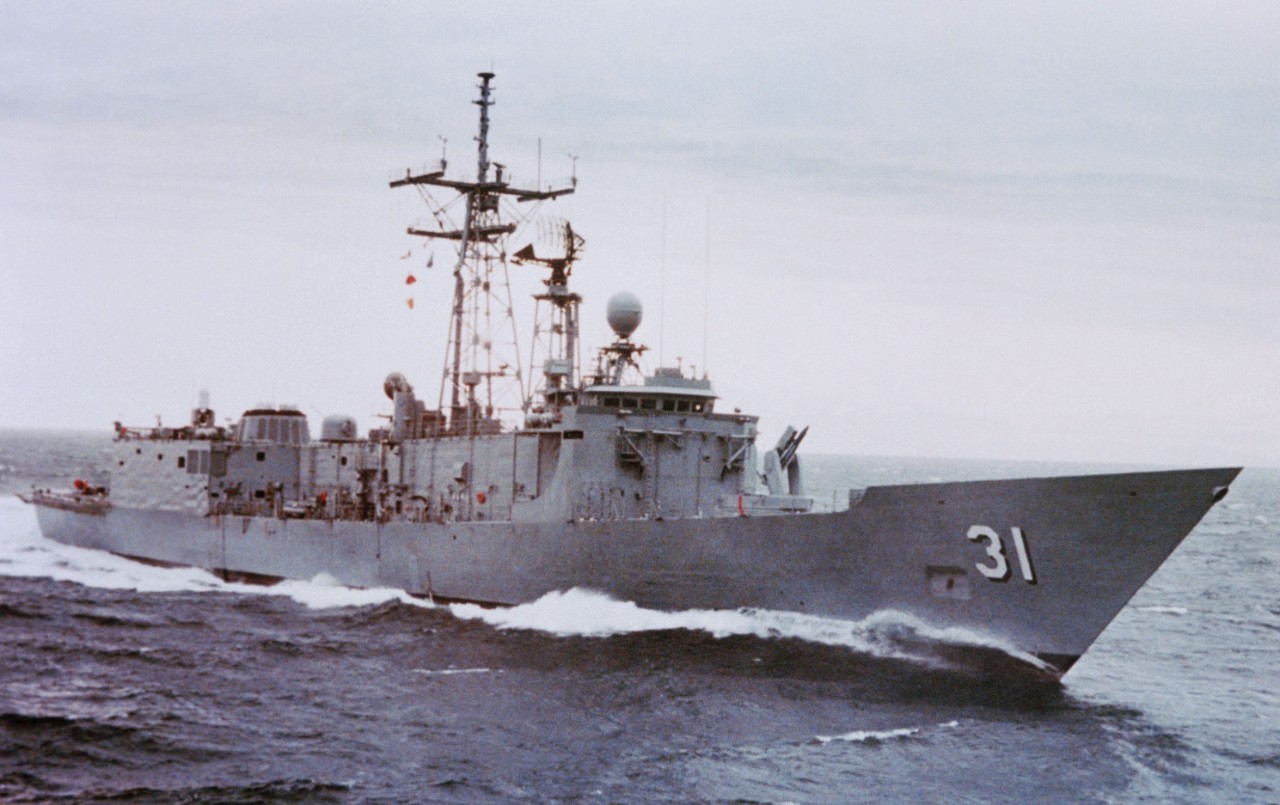
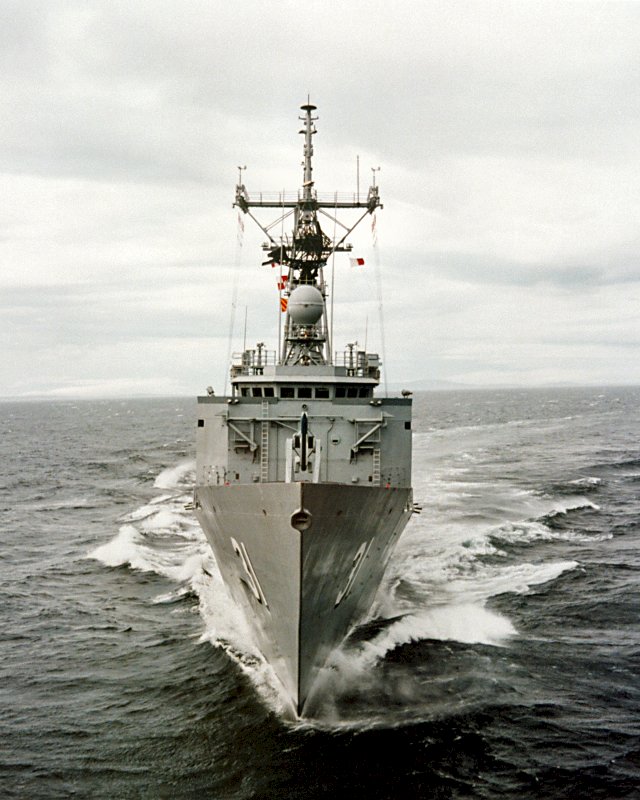
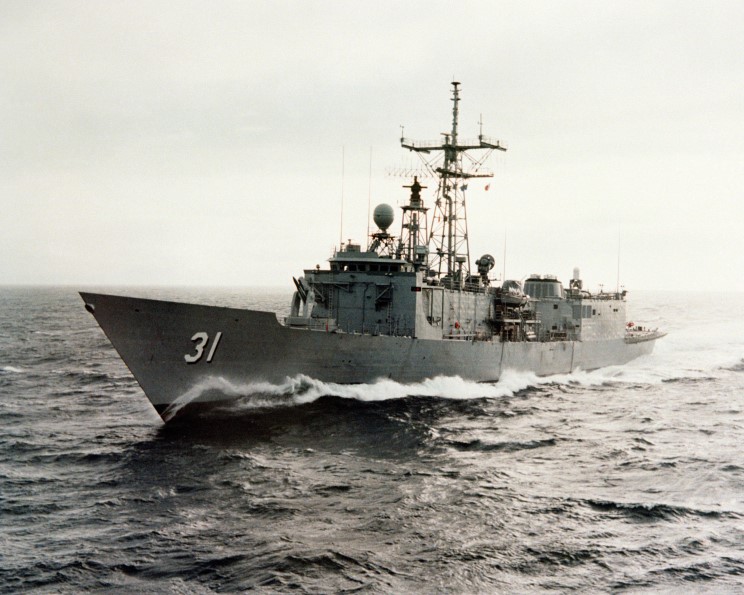
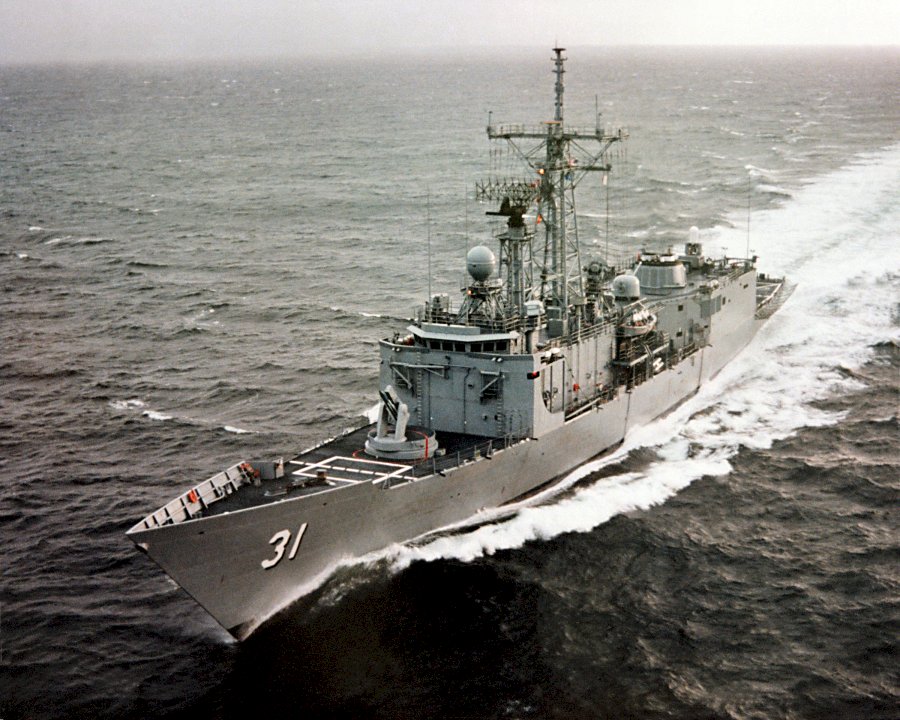
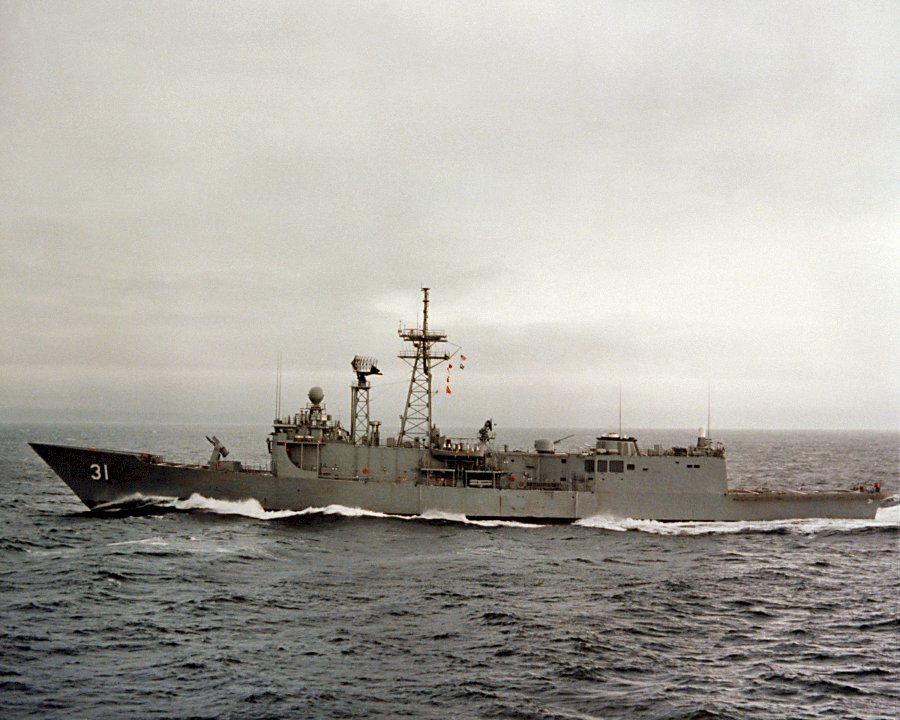
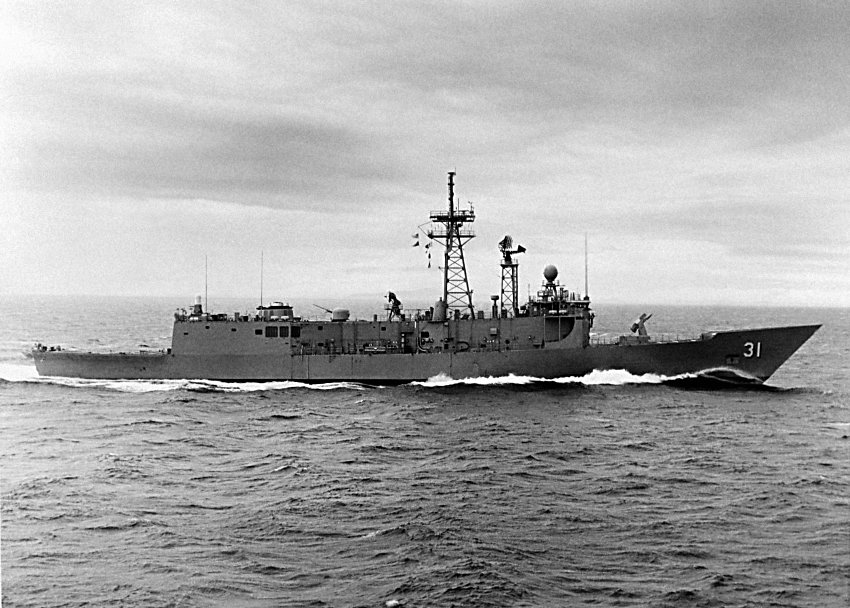
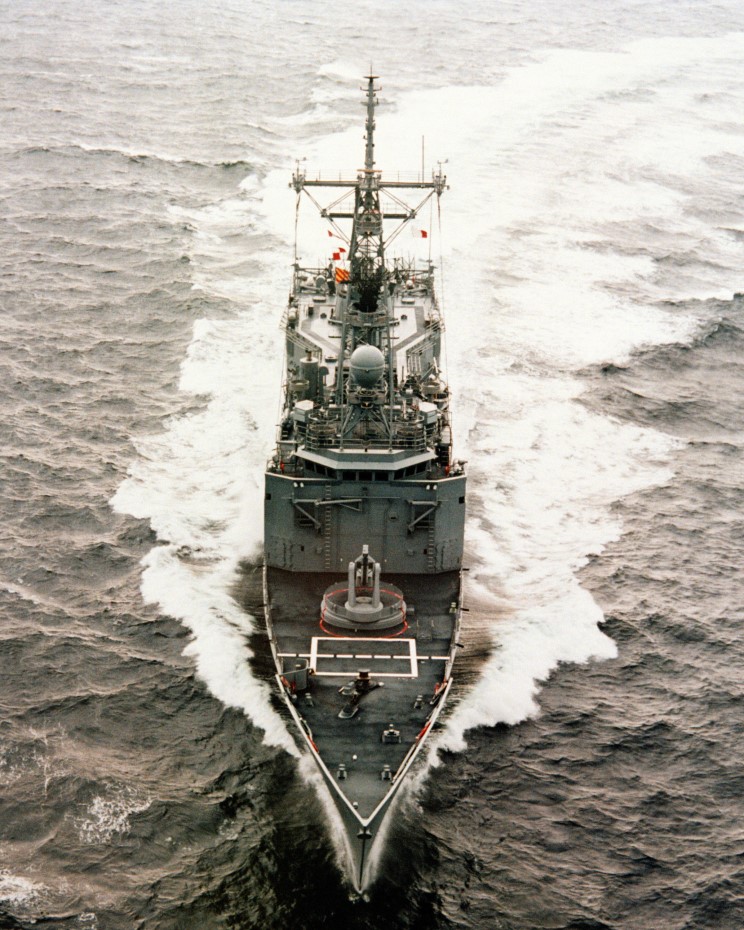
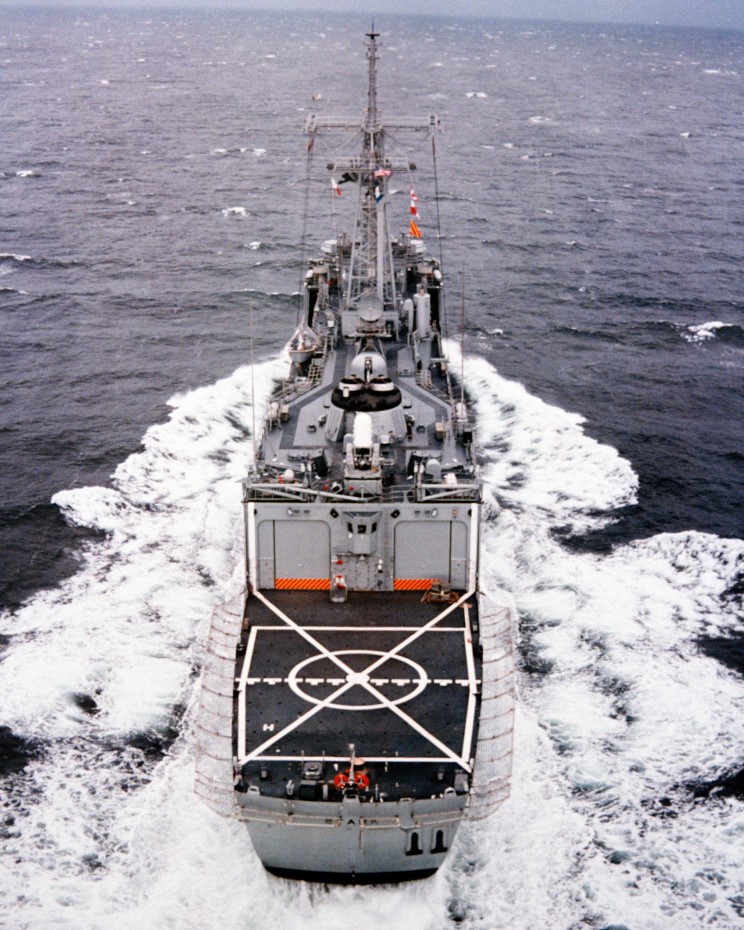
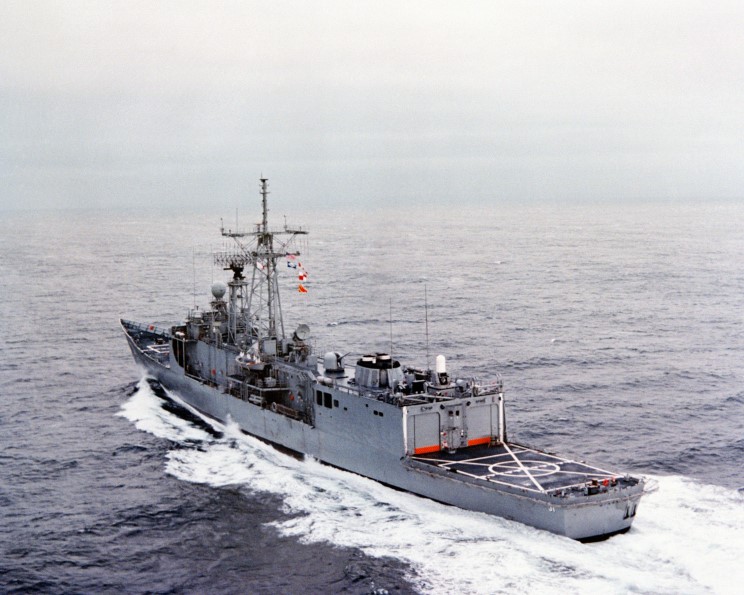
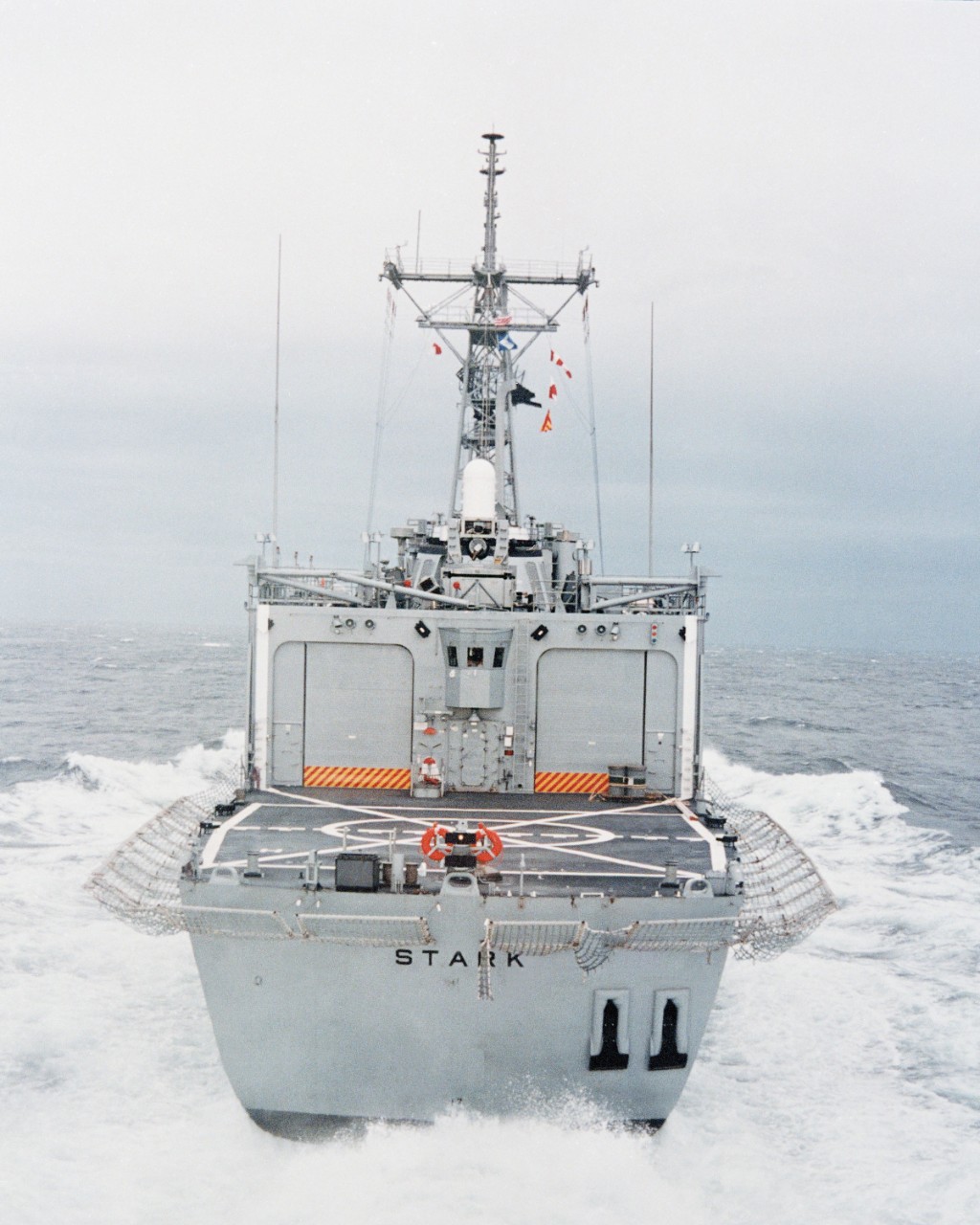
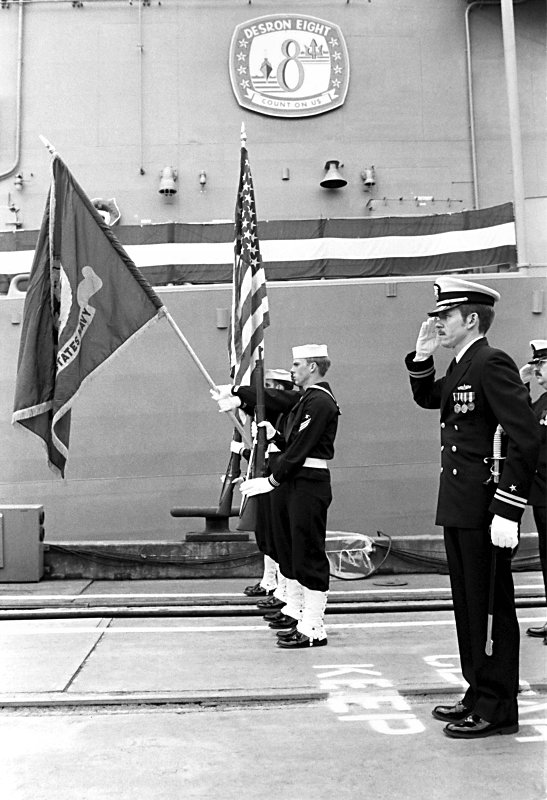
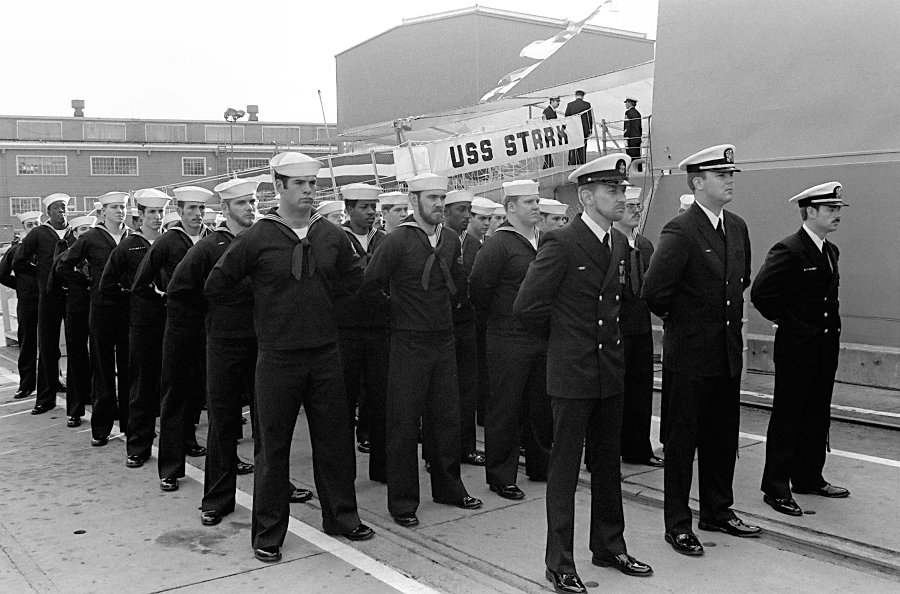
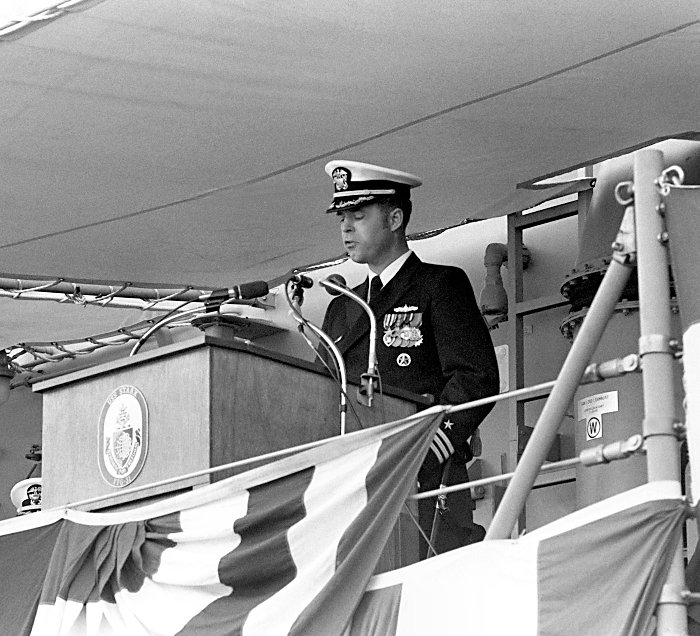
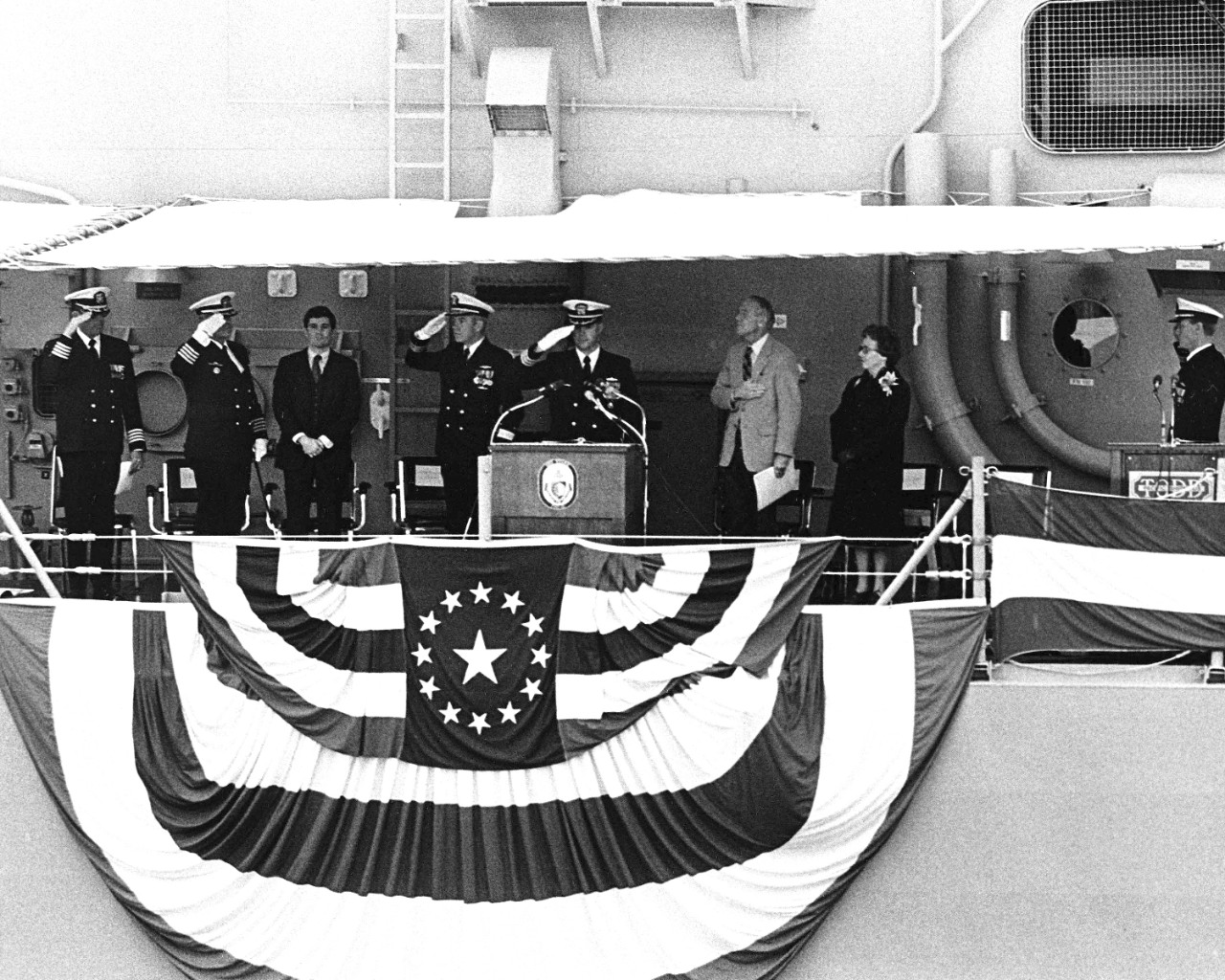
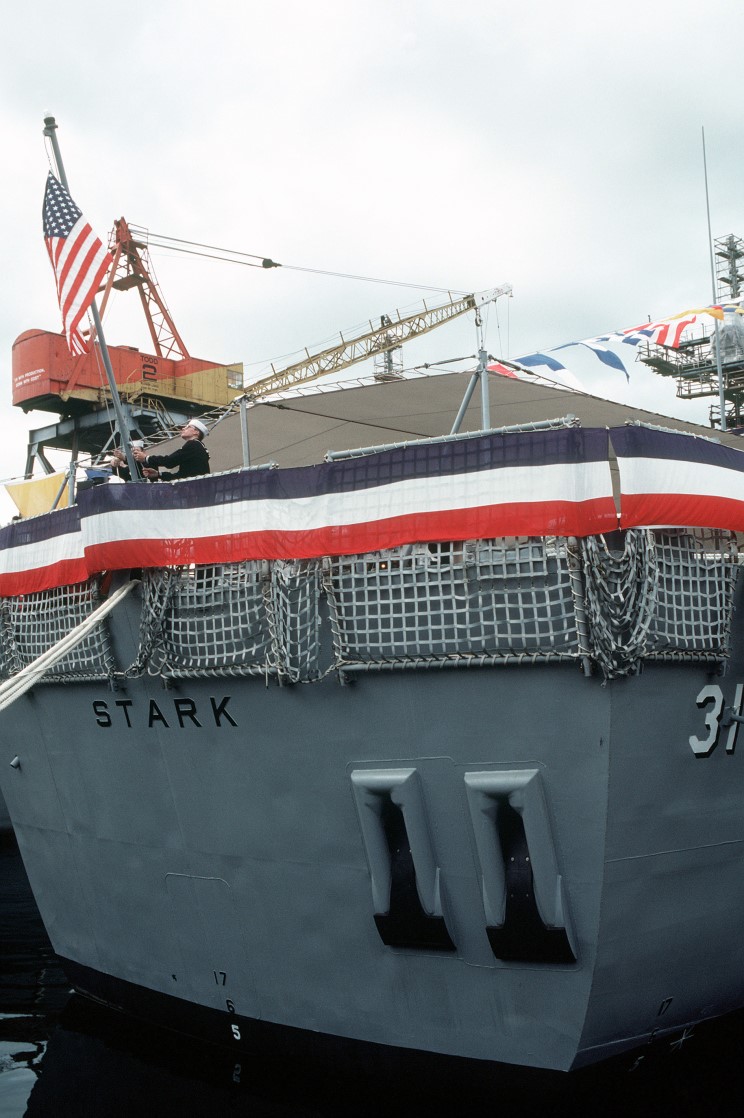
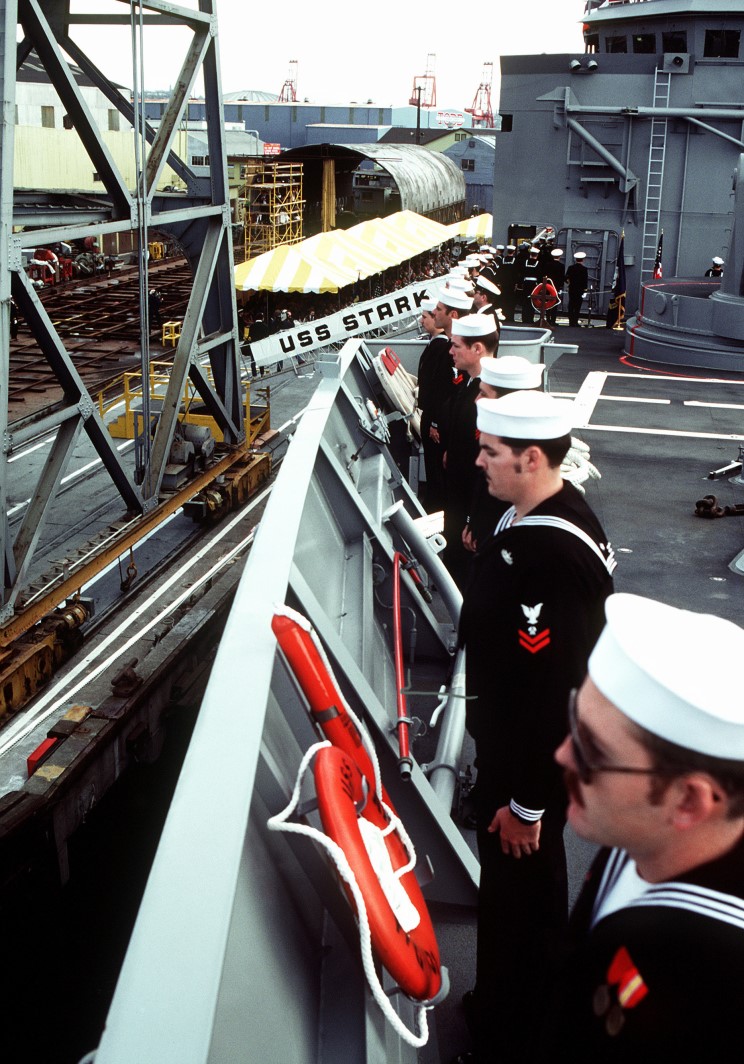
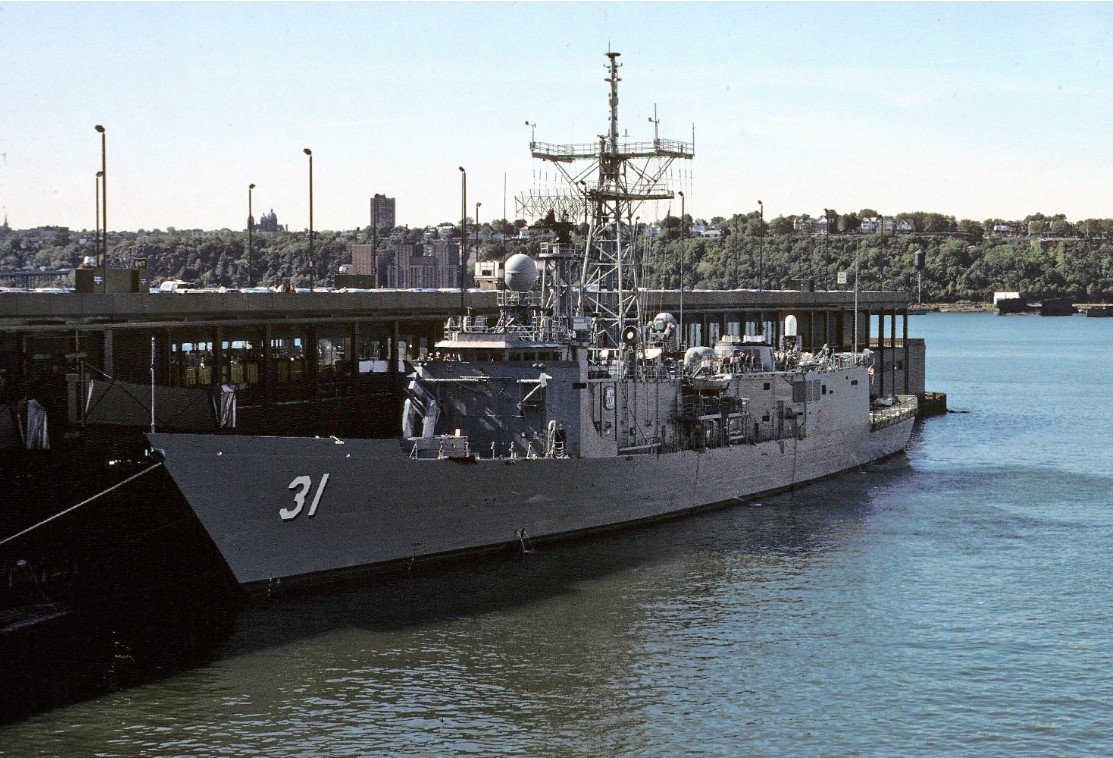
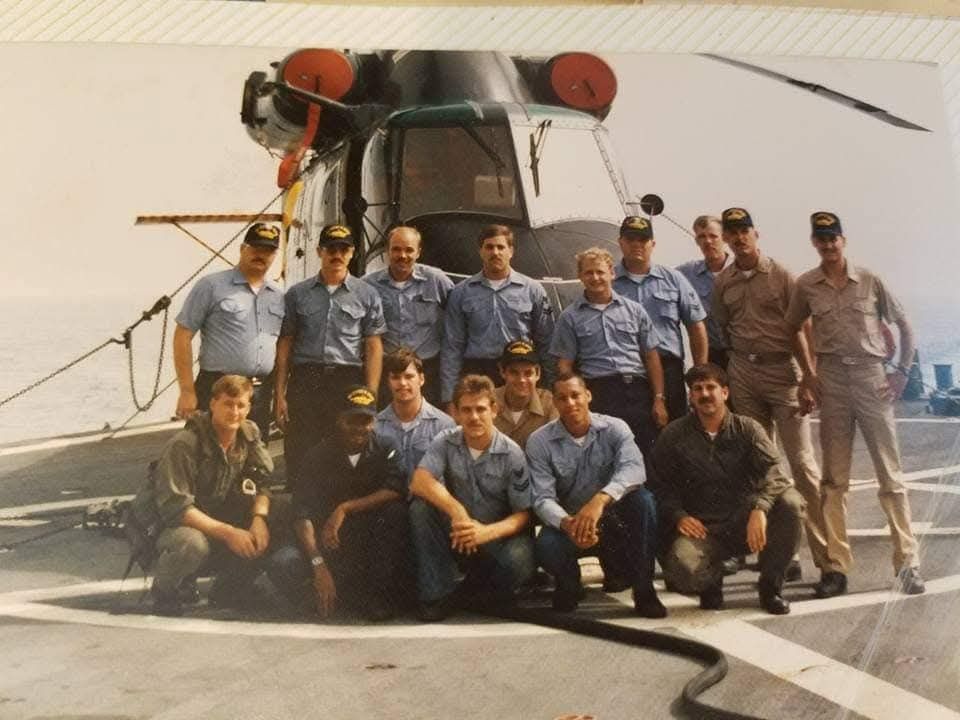
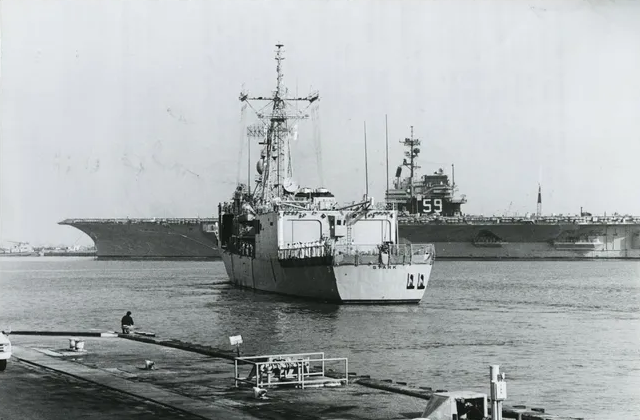
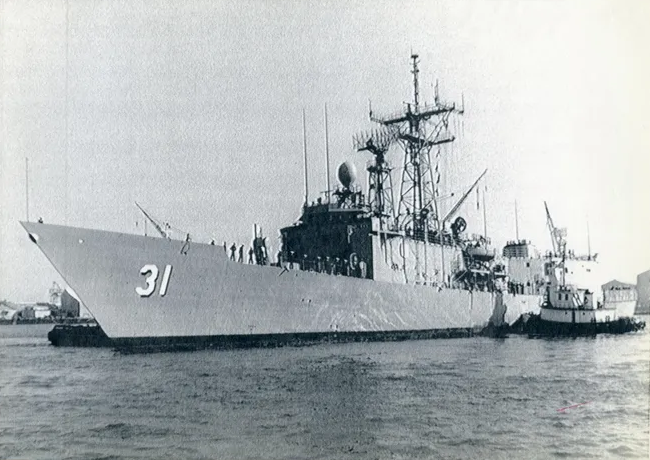
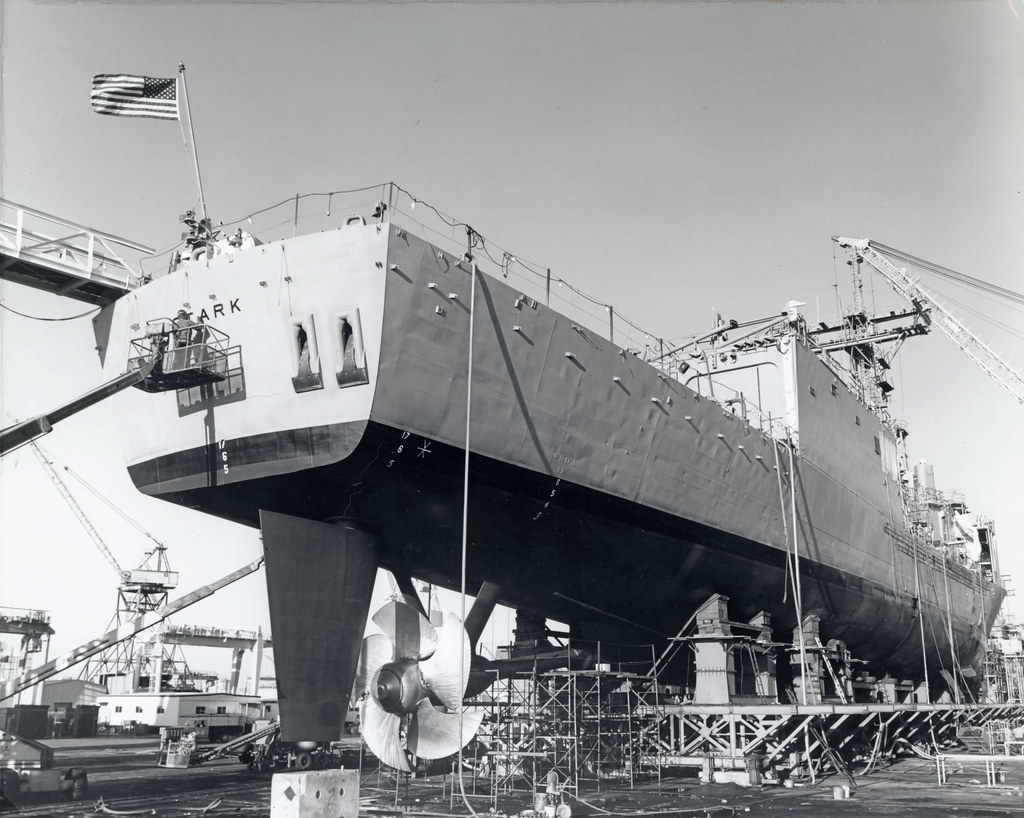
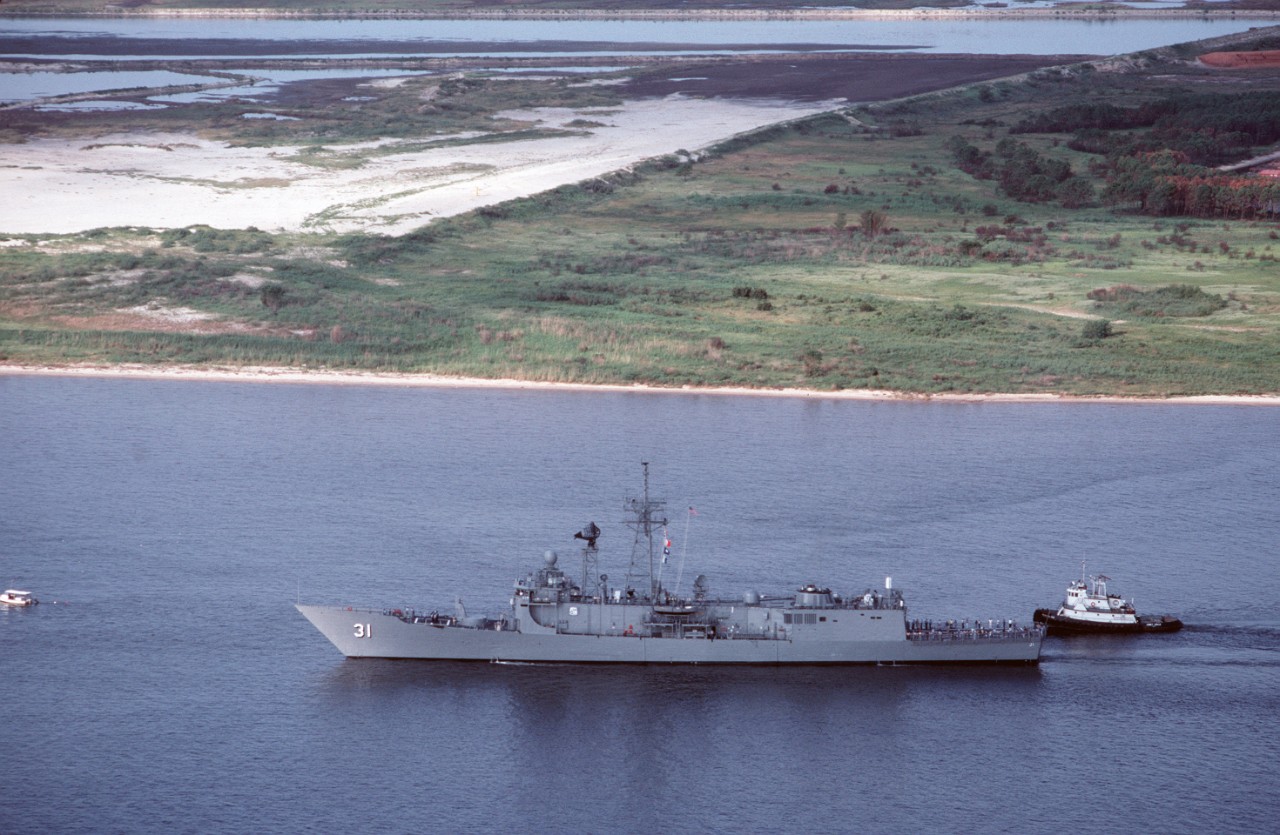
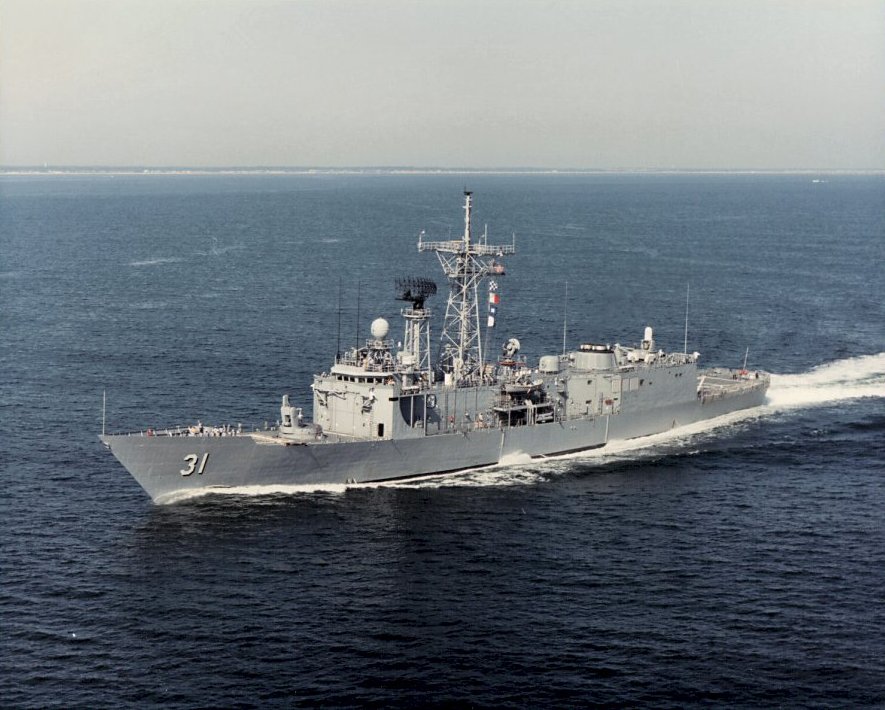
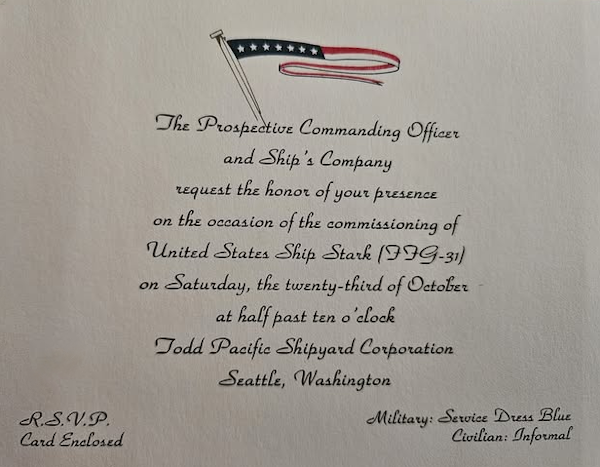 The USS Stark was build by Todd Pacific Shipyards in Seattle, WA. The keel was laid down on 24 August 1979 and launched on 30 May 1980. Sponsored by Mrs. Mary S. Semans, daughter of the late ADM Stark, the USS Stark was commissioned on 23 October 1982 with CDR Terrence W. Costello III, in command. The Stark was assigned to Destroyer Squadron (DESRON) 8 in Mayport, FL. Following commissioning, the Stark carried out a variety of sensors and weapons certifications and training evolutions designed to make her battle ready. The frigate was certified to carry RGM-84 Harpoon surface-to-surface missiles. After commissioning, SR Keith Galloway became the first sailor to report on board. She began crew certification on 19 November, a process that tested the sailors in their ability to operate the ship at sea and included fire, flooding, low visibility, loss of pitch and steering, and man overboard drills for each underway watch section. Stark onloaded ordnance for the first time while pierside at Naval Ammunition Depot, Indian Island, WA in late November. Stark celebrated Thanksgiving on 25 November while at sea by holding a turkey shoot, boxing matches, and arm-wrestling events, topping off the holiday with an old fashioned turkey dinner with all the trimmings. The frigate stopped in San Francisco to refuel and picked up provisions in San Diego. GSE2 Douglas W. Fox became the first sailor of the ships company to reenlist
during a ceremony on 2 December. Stark carried out the ship’s first underway replenishment when she refueled the
USS Aries The ship took part in a Harpoon missile exercise with the
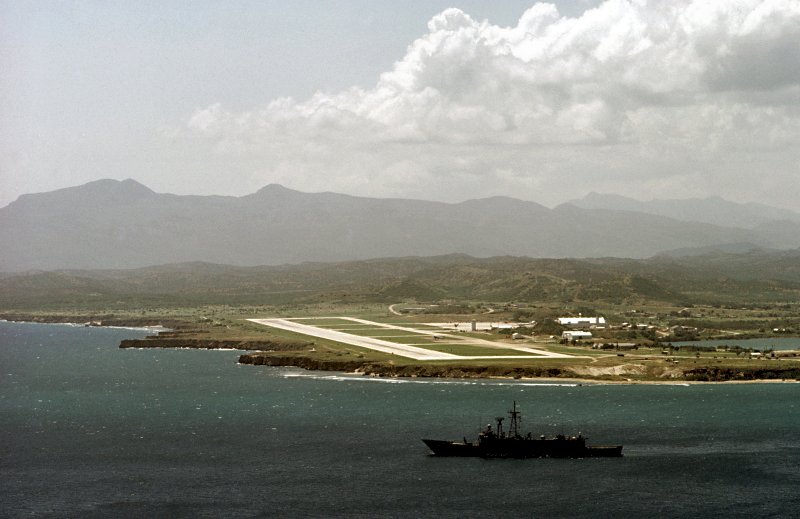
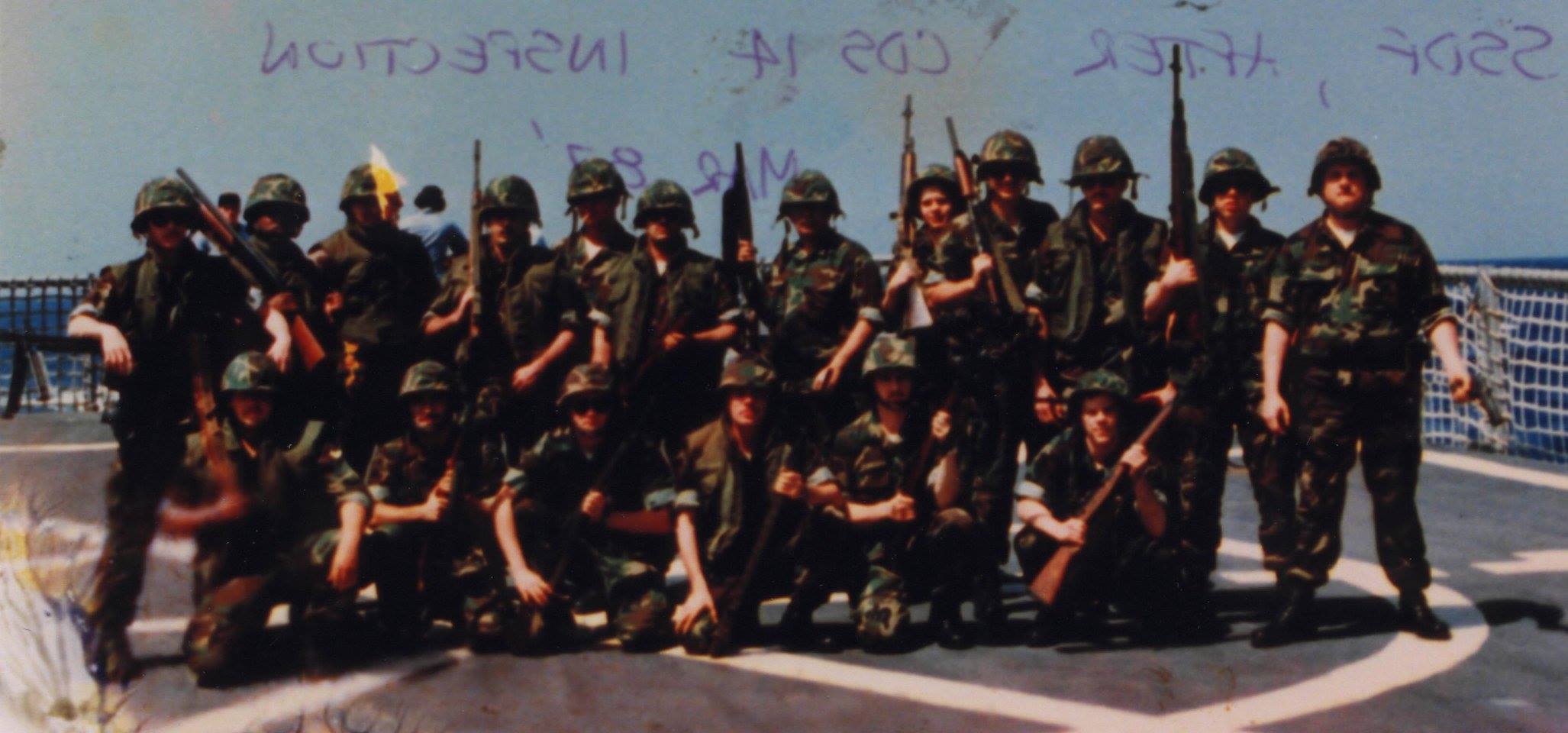
USS Samuel Eliot Morison 1983The following year, the ship accomplished her shakedown cruise off Naval Station Guantánamo Bay, Cuba in March and April, 1983. Stark then turned her prow northward and sailed along the east coast into New England waters. She steamed to Naval Weapons Station Earle, NJ, and offloaded weapons in June. Stark then visited Bar Harbor, Maine, and Newport, RI, before completing a post shakedown availability at Bath Iron Works at Bath, Maine from July to October. Following the yard work, she onloaded ordnance at NWS Earle, visited New York City, and carried out her deperming (a procedure that decreases a ship’s remnant magnetic field to protect it from magnetic mines) at Lambert’s Point Deperming Station near Norfolk, VA, and then trained while returning to Mayport. The frigate next trained in the Caribbean, refueling briefly at Naval Station Roosevelt Roads, PR, and set out from that port on 23 November for a series of independent steaming exercises. Stark’s foray into the tropical waters also afforded the crew the opportunity to visit St. Thomas in the Virgin Islands at the end of November, 1983. Stark’s history in 1983 illustrates a microcosm of the Navy as a whole that year. The ship steamed 14,870 nautical miles during the year, and burned 850,257 gallons of F-76 fuel for an average of 57.18 gallons per mile fuel consumption rate. The ship advanced 135 crewmen, gained 55 new men, transferred 33 to other duty, and separated six from the service. 1984After enjoying the Christmas and New Year holidays in Mayport, the frigate completed her fleet certification testing at Guantánamo Bay in February, 1984. She passed the tests a day early, which enabled the ship to make a quick stop in Miami, FL, on her way home to Mayport. Some of the crew’s wives made the trip from Mayport to spend the day with their husbands. Following the visit to Miami, the ship continued training at the Acoustic Underwater Testing and Evaluation Center (AUTEC) Range at Andros Island in the Bahamas. The evaluators assessed the ship’s effectiveness by using basic noise level analysis and progressed into advanced submarine hunting using the embarked Kaman SH-2F Seasprite LAMPS I of Helicopter Antisubmarine Squadron (Light) (HSL) 32 Detachment 2. The final stages of the training involved firing three exercise torpedoes against mini-mobile targets from the ship and her helo, achieving three kills. One day prior to completing the training, Stark was detached for a special operations mission that lasted eight days, and then returned to wrap-up the training. Stark, with an SH-2F Seasprite of HSL-32 Detachment 2 embarked, set out for a composite unit training exercise (CompTuEx) and Ocean Venture in April-May, 1984. The ship carried out weapons firing exercises in Puerto Rican waters, launching two SM-1 Standards against target drones and firing the CIWS against simulated cruise missiles, all of which observers evaluated as kills. Stark also shot her 76mm gun in the naval gunfire support role, and then visited Paradise Island in the Bahamas. The frigate accomplished the next phase of the exercise in a simulated war against members of the opposing forces across the Gulf of Mexico, and claimed “several undetected strikes against numerically superior forces.” She came about and took part in Ocean Venture on the way home. At dawn on 22 September 1980, Iraqi guns unleashed a thunderous barrage upon the Iranians and nine divisions advanced into Khuzestan, beginning a war between the Iranians and Iraqis that escalated and threatened ships steaming in those waters. On 12 August 1982, Iraqi President Saddam Hussein declared a maritime exclusion zone that permitted attacks against ships sailing within the specified boundaries, and journalists dubbed the fighting at sea as “The Tanker War.” 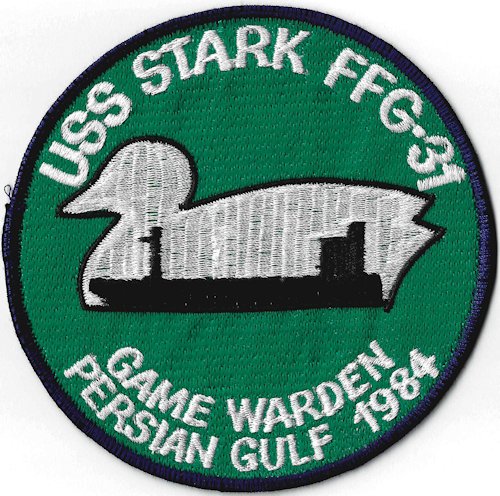 Stark made her maiden overseas deployment during a voyage to the Middle East Force (MEF) in the Persian Gulf, 4 June to 3 December 1984. The frigate refueled at Bermuda two days out, crossed the Atlantic Ocean and took on fuel in the Azores on 12 June 1984, and again at NS Rota, Spain, on 16 June, and then passed through the Strait of Gibraltar into the Mediterranean Sea. The ship visited Palma de Mallorca, Spain, to allow the crew to rest before continuing her journey into the volatile Middle East. Stark then steamed across the Mediterranean, passed southbound through the Suez Canal on 26 June, crossed the Red Sea, and briefly stopped to refuel at Djibouti at the strategic Horn of Africa on the last day of the month. She resumed her voyage around the Arabian Peninsula, sailed through the Strait of Hormuz and entered the Persian Gulf, refueling and repairing damage sustained during her cruise while at Mina Salman at Bahrain on 7 July. The merchant port based some Bahraini patrol boats but did not host a USN station, and the Navy’s Administrative Support Unit lay approximately five miles from the pier and comprised the nearest US base. Some of the ships company on liberty utilized the limited recreational facilities available at the unit, or shopped in the local market. Despite being moored to the pier, the limited logistic support compelled the ship to take on fuel and water by barge, and food and stores by a combination of the pier and barge. 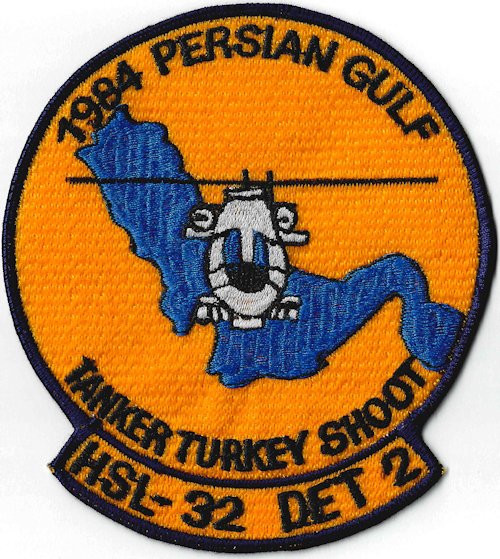 Stark then began patrolling the sea lanes, the ship’s historian reporting that she operated “in one designated station or another,” monitoring aircraft and
vessels and their radio communications. In addition, the frigate at times escorted the MEF’s command ship,
USS La Salle Stark visited Bahrain in July 1984, and concurrently with the
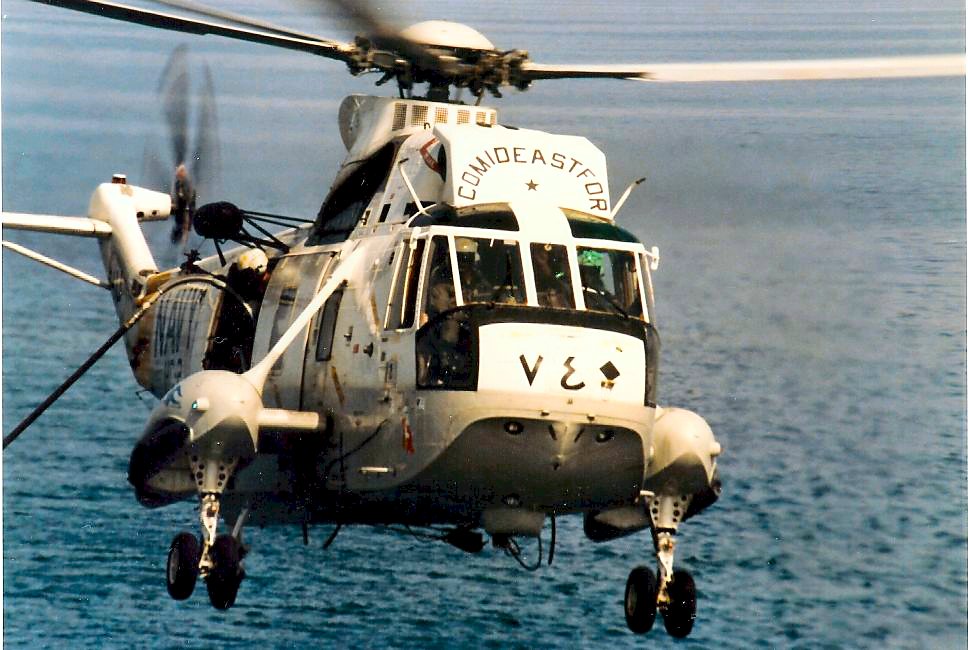
USS Julius A. Furer Lookouts on board Stark heard four loud explosions at 0915 on 19 October 1984, as Iranian missiles plunged into Pacific Protector, a 1,538 ton diving support ship. Stark dispatched her embarked Seasprite to investigate, and a short time later the aircrew sighted the ship ablaze, about 20 miles from the frigate. The helo hovered near the scene while Stark came about and made for the area at maximum speed. The Seasprite meanwhile spotted survivors gathered on the ship’s fantail and returned to the frigate for a lift stretcher and to refuel. The helo then returned to Pacific Protector and in a two trip lift, brought back two badly injured men. The first man succumbed to his injuries and was pronounced dead on arrival. The ship’s medical team treated the second victim but he too died a short while later. Stark meanwhile reached the area of the attack, lowered her motor whaleboat, and the boat’s sailors rescued all of the remaining 16 survivors and returned them to the ship in two trips. The frigate’s hospital corpsman and his assistants treated the survivors and later that day the MEF’s Sea King transported all of them to Bahrain for further medical treatment (and also flew the two dead mariners ashore). Following that sobering day, a marching band and a pipe band welcomed Stark when she eased in to Mina Saqr in the United Arab Emirates at the end of October. The ship’s return home proved uneventful, and she came about from the Persian Gulf on 7 November, refueled at Djibouti on 10 November, and again at Rota and the Azores, before her crewmen saw the welcome sight of Mayport. 1985Stark returned home for an expected post-deployment standdown, but early in the New Year of 1985, growing U.S. concerns over the threat posed by the expansionism of the leftist Sandinista National Liberation Front in Nicaragua led Secretary of Defense Caspar W. Weinberger to authorize an increase in operations off Central America, in order to deter the Sandinistas and to demonstrate US support for El Salvadoran elections. The Navy therefore interrupted Stark’s usual cycle of post-deployment training and upkeep and tasked her for Central American surveillance operations from 14 January to 16 March. The ship embarked a detachment of Cryptologic Technicians, passed through the Panama Canal into the Pacific Ocean, and patrolled along the west coast of the Central American isthmus. Following Stark’s return to Mayport, the ship completed an intermediate maintenance activity availability there through 23 April, and then stood down the channel and tested her machinery and equipment off Florida. She then took part in Solid Shield 1-85, an exercise that emphasized joint command and control of the forces involved, screening the amphibious ready group from submarines.  While the
USS Vreeland After Stark visited Chicago, she made a same day passage to Milwaukee, WI, for a four day visit. From there the frigate passed through the Sault Sainte Marie locks, crossed Lake Superior and visited Duluth, MN, where members of the local Veterans of Foreign Wars greeted her with a 21-gun salute. Duluth marked the ship’s westernmost point reached during her Great Lakes sojourn. Stark stood down that channel and made a same day transit to Thunder Bay, Ontario, to that port marking her northernmost point during the cruise. After Thunder Bay the ship returned through the Sault Sainte Marie locks, anchored, and visited St. Ignace, MI, a small summer resort town on the shore of Lake Michigan. Stark then crossed Lake Huron, transited the St. Clair and Detroit Rivers, and crossed Lake Erie to call at Port Colborne, at the southern terminus of the Welland Canal in Ontario. Upon leaving Port Colborne, Stark made a same day sail and eased into Cleveland, OH, later that afternoon, Navy recruiters arranging a festive welcome with balloons, bands, and clowns. Some of the ship's crew were invited to a Chicago White Sox double header in which Captain Brindel threw out the first pitch. After an activity-packed four day visit to Cleveland, the ship put in to Erie, PA, for three days. The frigate stood out of that port, returned up the Welland Canal on the night of 5 August, anchored, and visited Toronto. The warship then trained for two days while anchored on Lake Ontario before stopping at Oswego, NY for a four day visit. At that point she came about for home, and navigated the Saint Lawrence Seaway for the second time, anchoring, and stopping at Québec overnight for a final port visit and to load supplies, before resuming her voyage to Mayport. Stark welcomed more than 105,000 visitors during her Great Lakes cruise. The crew hoped for an extended period to spend with their loved ones but Hurricane Elena compelled the ship to emergency sortie to evade the storm. Stark then screened amphibious ships during ALARG 1-85, returned to Mayport and completed ALANG 1-85, but then fled Hurricane Isabel in September. The ship had scarcely escaped Isabel and began carrying out upkeep when Hurricane Kate marked the third time during the fierce hurricane season that she emergency sortied. Stark trained at the AUTEC Range in the Bahamas in November, and finished the year completing SRA I, a selected restricted availability, at Atlantic Marine Industries, Mayport Division. 1986Here is a Welcome Aboard guide with featuring Commander Brindel and BMCS Fischer. The warship
accomplished a series of training exercises and maintenance through the winter, and then visited Nassau for a couple of days and trained at
AUTEC. Following a series of readiness inspections, Stark joined the
USS Antrim 1987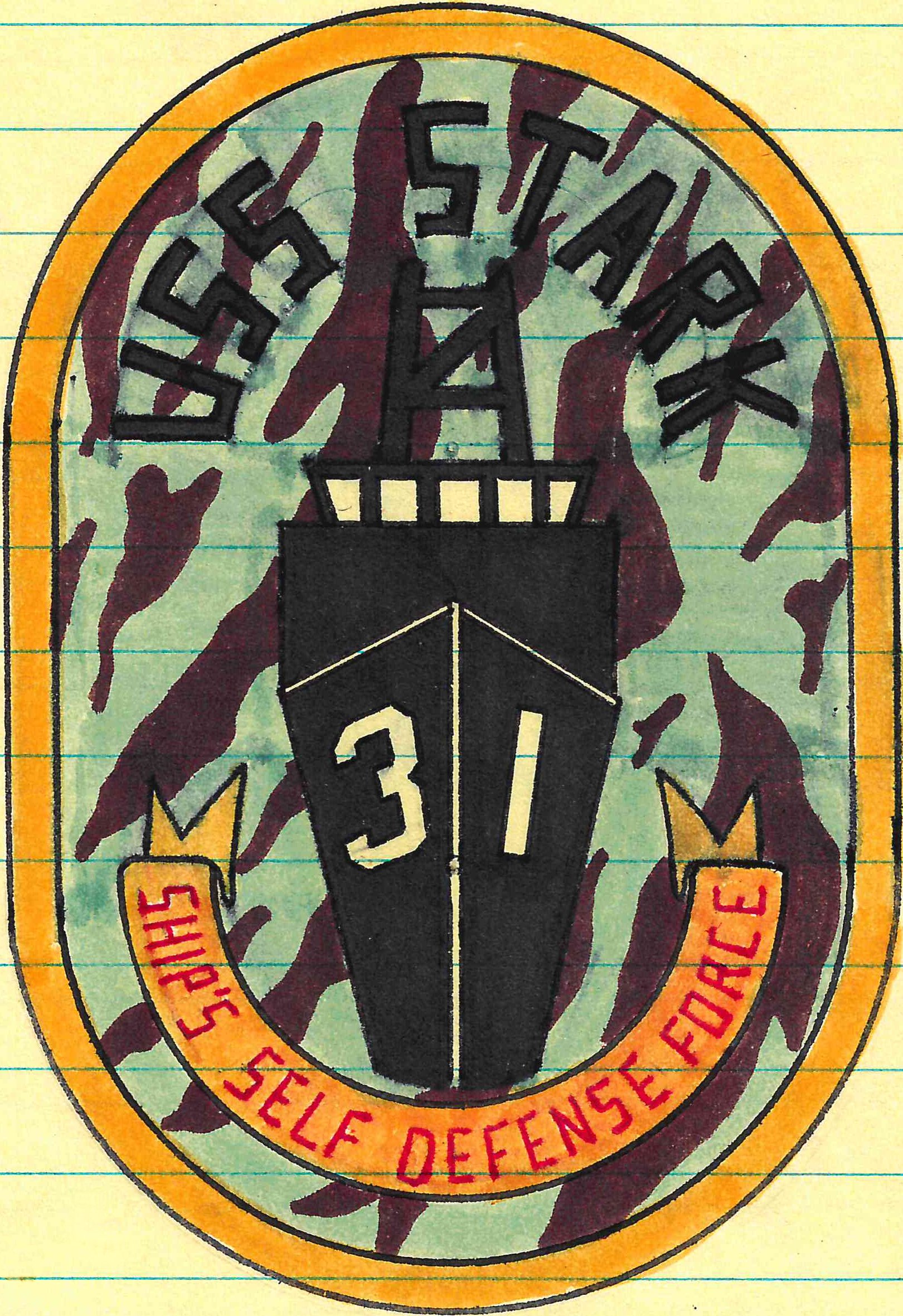 Stark, with a Seasprite from HSL-32 Detachment 3 embarked, and in company with the
USS Stephen W. Groves The Tanker War escalated, however, and the US Navy and its allies consequently became increasingly involved in short but fierce battles in the region as
the coalition attempted to restore the balance of power, escorting reflagged oil tankers and monitoring the fighting. Stark briefly patrolled the Persian
Gulf and then anchored at Sitra Anchorage at Bahrain, where the USO entertainment troupe Debbie Cox and Borderline treated the crew to a show. The ship stood
out of the anchorage and departed the Persian Gulf to patrol the northern Arabian Sea, on 17 March participating in an antisubmarine exercise with a Pakistani
submarine and Pakistani destroyers Babur (D.182) and Shah Jahan (D.164), formerly the USS Harold J. Ellison (DD-864). She visited Karachi and following that
port call, came about and returned to the Persian Gulf, observing Iranian and Iraqi aircraft and ships during her passage and taking on provisions and fuel
while anchored at Sitra on 28 March. The frigate resumed patrolling the explosive region, received the remaining JP-5 aviation fuel from the
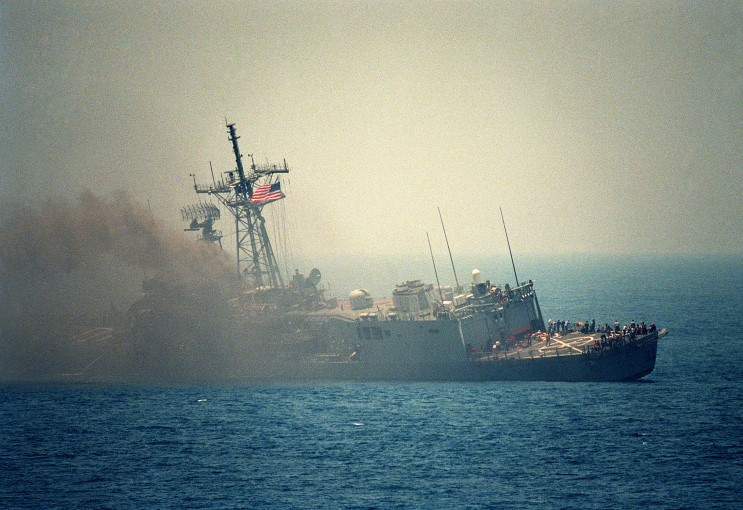
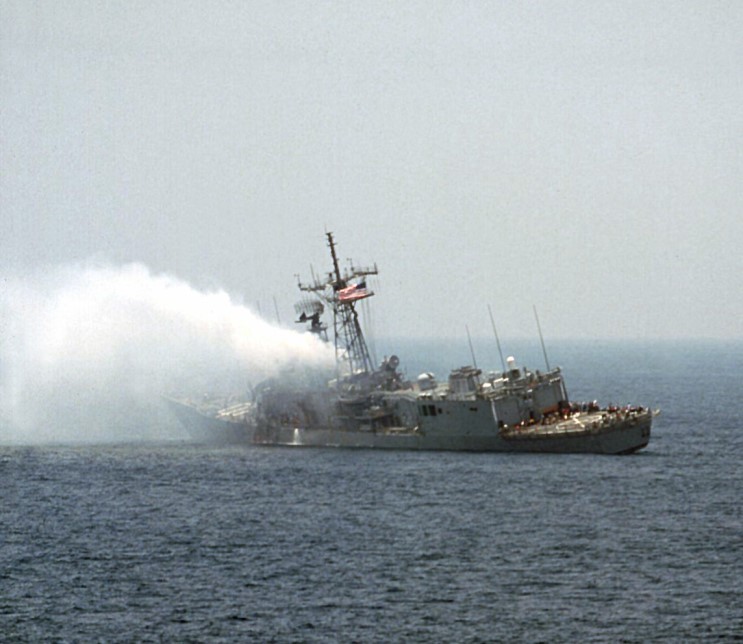
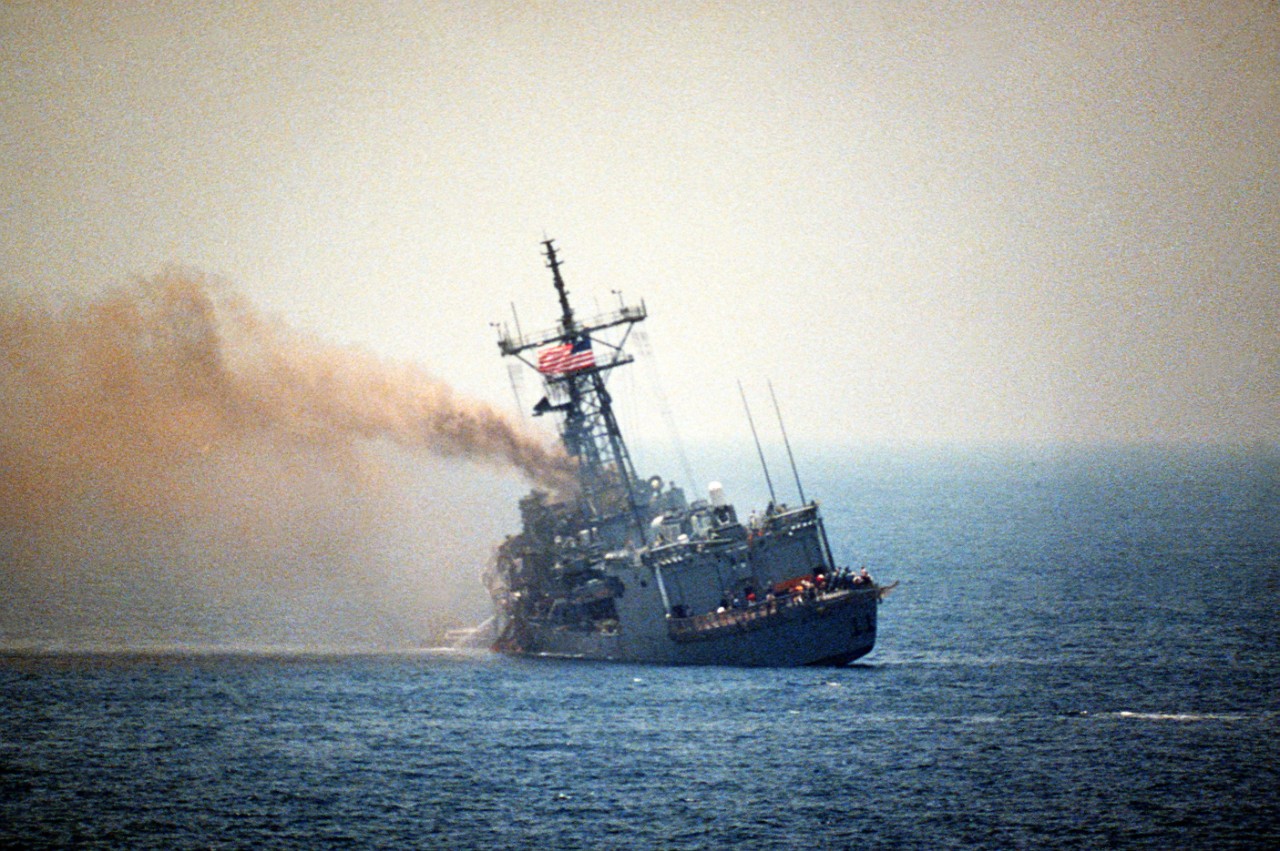
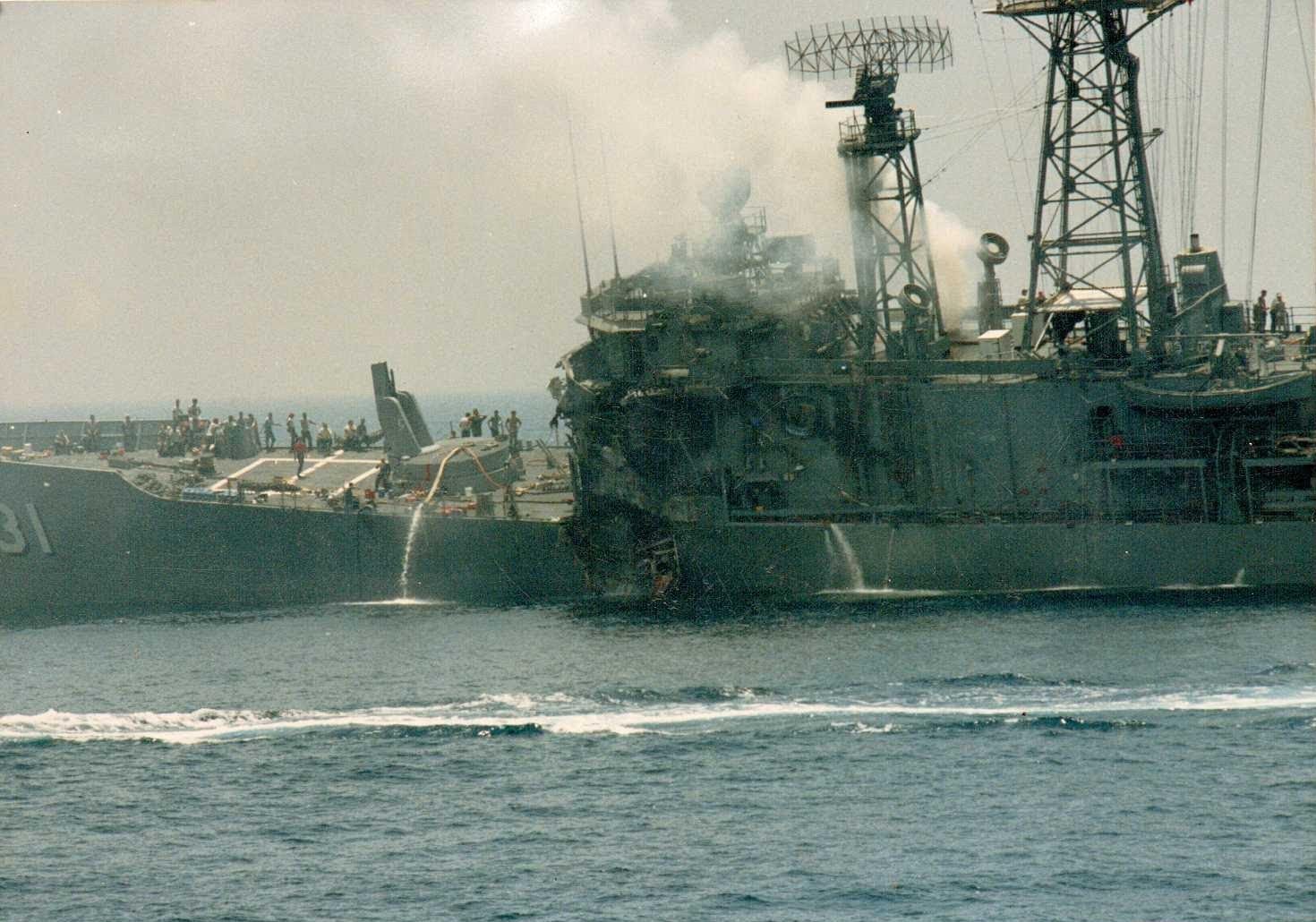
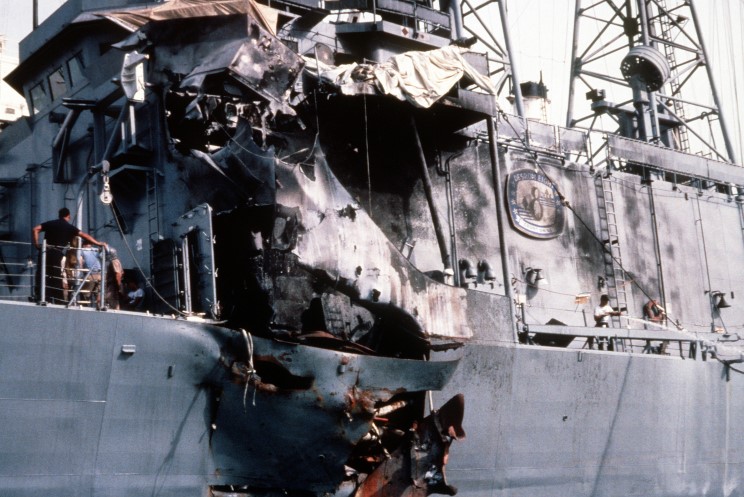
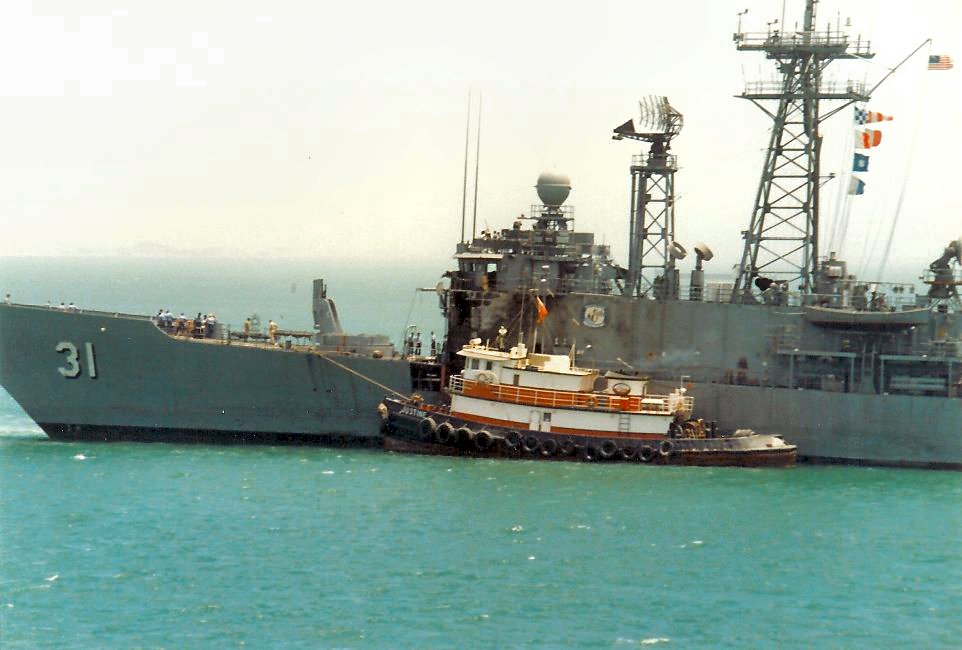
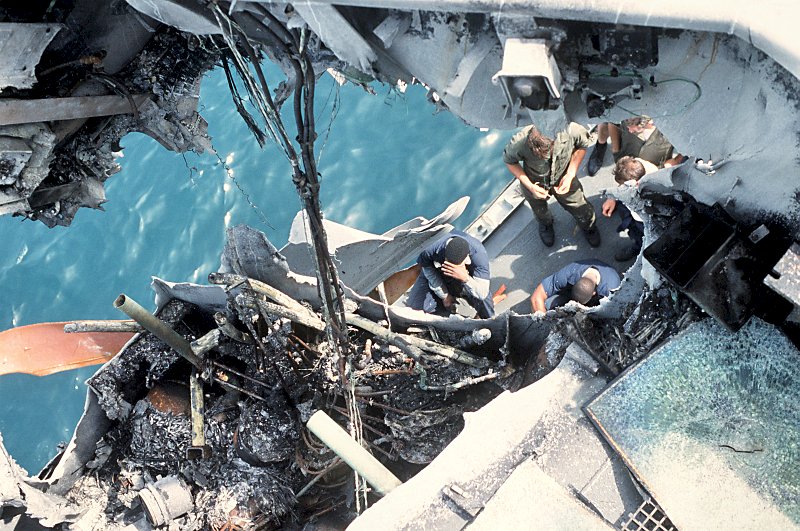
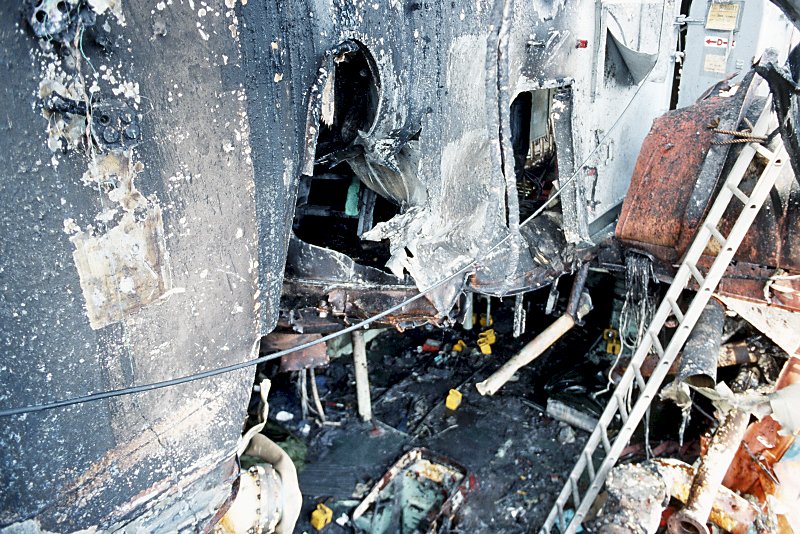
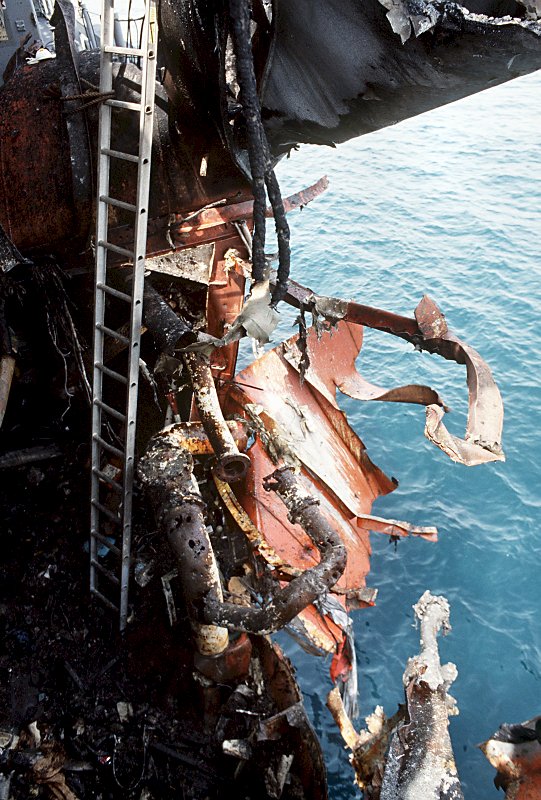
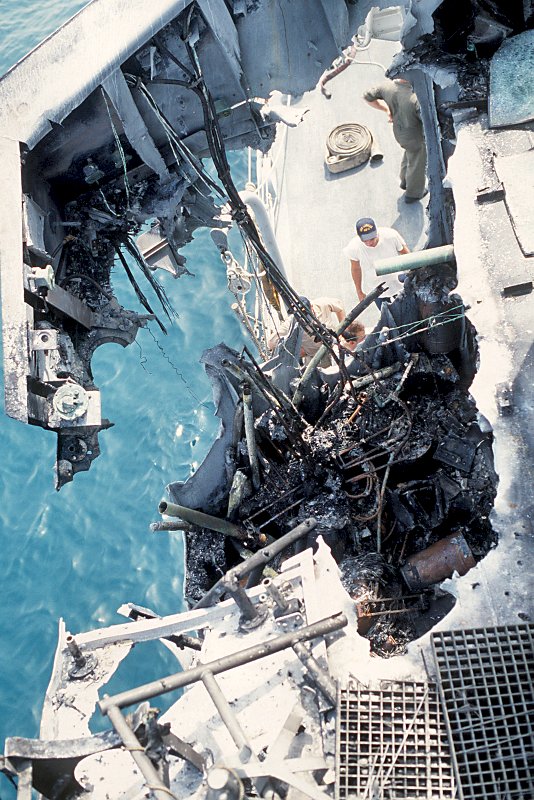
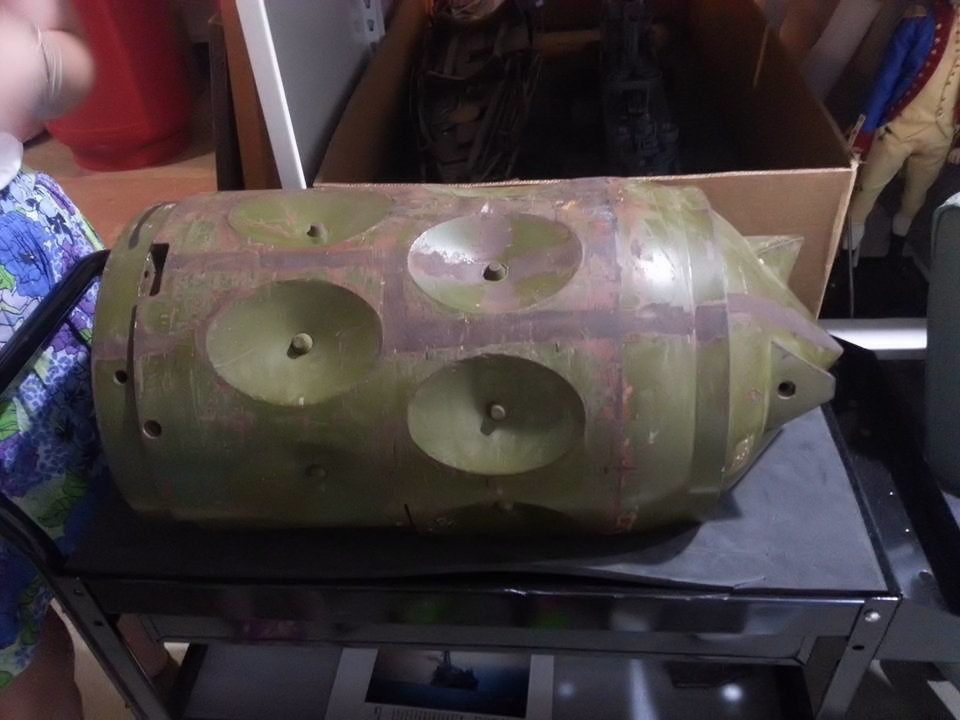
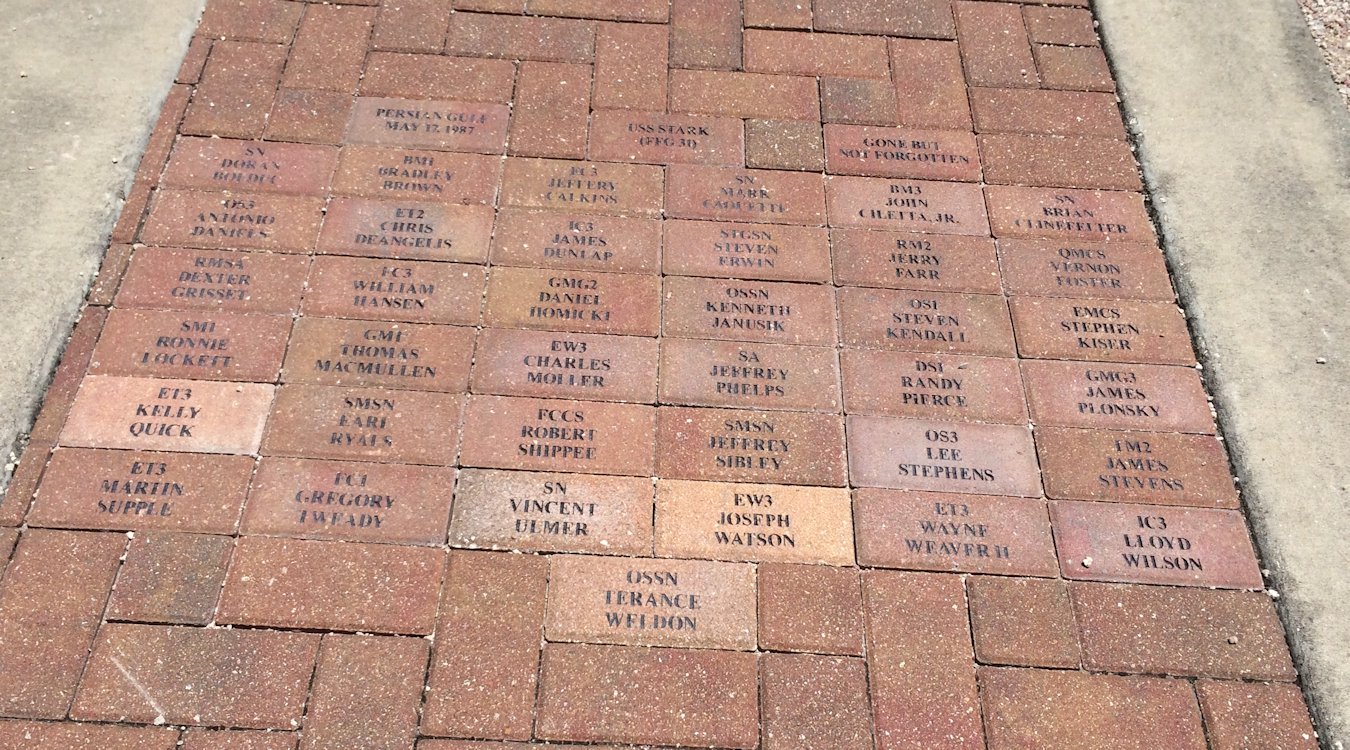
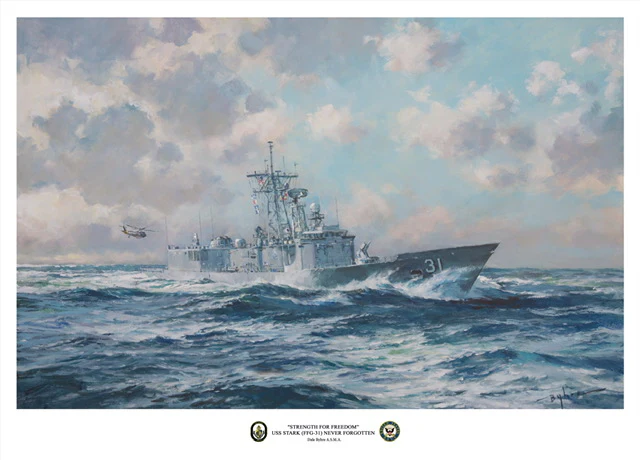
USS Hepburn 17MAY87Stark stood out of Mina Salman at 0510 on 17 May 1987, in preparation for receiving the Gas Turbine Mobile Training Team on 19 May. She cleared restricted navigational waters by 0930 and proceeded to patrol an area west of the Iranian-declared exclusion zone. Stark steamed with bright navigational lighting, as required by international rules of the road. The frigate participated in what the Navy later announced as a “two-way computer data exchange” with the La Salle, Coontz, and a USAF Boeing E-3A Sentry Airborne Warning and Control System (AWACS). These crewmen relayed to each other relevant information concerning airborne contacts such as geographical position, course, speed, altitude, and assumed or confirmed identity. The AWACs reported an unknown aircraft flying south over the Persian Gulf at about 1700. At 1743, the Coontz reported this aircraft bearing 285º at a range of 120 nautical miles from Stark. The frigate detected the contact on radar fifteen minutes later, bearing 260º and closing at a range of 70 nautical miles. A dusty haze hung heavily in the air as the sun began to set. The Iraqis had launched a Dassault F.1EQ-5-200 Mirage equipped with two AM.39 Exocet air-to-ground missiles, however, and the pilot maneuvered aggressively, apparently intent on attacking what he believed to be a tanker servicing the Iranian oil trade. Coontz noted that the Mirage turned to an easterly heading at 1800, flying at a speed of 290 knots at an altitude of 3,000 feet. Stark came about to a course of 300º at ten knots, near 26º47’N, 51º55’E. Coontz then reported on the net: “Iraqi aircraft bearing 043º, range 45 nautical miles, course 066º, speed 335 knots, altitude 3,000 feet, heading toward Stark.” La Salle queried Stark as to whether she monitored the intruder, to which the frigate replied, “Affirmative.” Stark’s AN/SLQ-32(V) electronic support measures system then detected a radar signal, which her sailors evaluated as a search mode airborne fire control radar, and correlated the signal to the Iraqi jet, bearing 269º but closing at 27 nautical miles. Stark issued a warning by voice radio over the military distress net (243 MHz), identifying herself as a US Navy warship, and when the jet closed to only 12 miles, repeating the warning within a minute. The Iraqi disregarded the warnings, and from 1808–1810 the Sentry observed the Mirage bank sharply to the right and increase speed as the jet launched a pair of Exocets. Almost simultaneously, Stark detected the Iraqi’s fire control radar lock on to the ship, and her port lookout spotted a missile inbound. The frigate locked her fire control onto the jet (1809–1810), but mere seconds later the first missile slammed into the port side nearly 13 feet above the waterline, under the port bridge wing and at about Frame 100, on the second deck. The Exocet did not detonate but tore into the ship, severing the firefighting water lines to the forward part of the ship, and breaking apart and spilling volatile fuel. About 25 seconds later, the second missile hit a few feet aft of but nearly in the same location, and exploded in Crew Compartment 2-100-0-L, the fuel from the first missile feeding its fiery detonation. The shock of the hits tore fixtures from bulkheads and wrecked equipment. The heat from the fires and the acrid and blinding smoke impeded damage control efforts, and flames melted aluminum superstructure and decks. Men off watch asleep in their racks awoke to an inferno and screamed as they died. LT William A. Conklin, the ship’s 27-year-old Damage Control Assistant, had just completed a long day of watches and at sea routine and settled into his rack for some eagerly awaited sleep when the first missile struck with a crashing roar. Conklin leapt to his feet and rapidly donned coveralls and shoes as the bridge passed a chilling order over the 1MC: “Inbound missile, port side, all hands brace for shock.” The second Exocet struck the ship, and the lieutenant raced for his battle station in Damage Control Central, where he learned to his horror that the attacks all but severed the fire-fighting system. The blaze reached super-heated temperatures and threatened the ship, so Conklin and HT1 Michael J. O’Keefe crawled through the fire despite the agonizing pain from the heat and closed the critical firemain valves, isolating the torn pipes. “It was a fight for survival,” O’Keefe later summarized. “I was fighting to stay alive.” The blaze also engulfed the chiefs berthing/lounge, ships store, post office, and barber shop, and damaged other areas. Crewmen used a P-250 pump to supply water to battle the flames in the forward section of the ship, and supplemented their efforts at multiple points by using electric submersible pumps. Sailors felt heat rising from the deck into their feet but bravely directed water onto the flames, only to discover with dismay that the heat turned the water into scalding steam. The men poured so much water onto the frigate that she listed dangerously up to 17 degrees to port from the weight. The attack severed some of the ship’s communications, so sailors creatively rigged a “salt and pepper” line with sound powered phones between the bridge, aft
steering, and the flight deck in order to direct their battle against the conflagration. The fire-fighters realized with horror, however, that they often could
not communicate with each other directly, and afterward recommended that the Navy equip ships with hand-held radios or walkie-talkies. Crewmen threw FIM-92
Stinger man portable air defense missiles and .50 cal. rounds overboard to prevent them from exploding. LT Carl S. Barbour rescued 28-year-old FC3 James Wheeler
moments before the flames reached him. The men used 40 Oxygen Breathing Apparatus canisters (18 above their normal allowance of 22) that provided oxygen for
a limited time, but used all of them by 0115 during the mid watch, effectively halting their efforts to fight the blaze until a boat from the
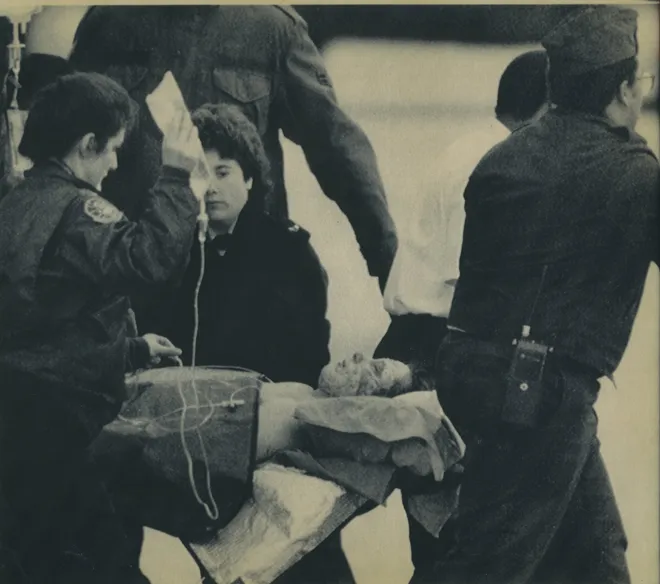
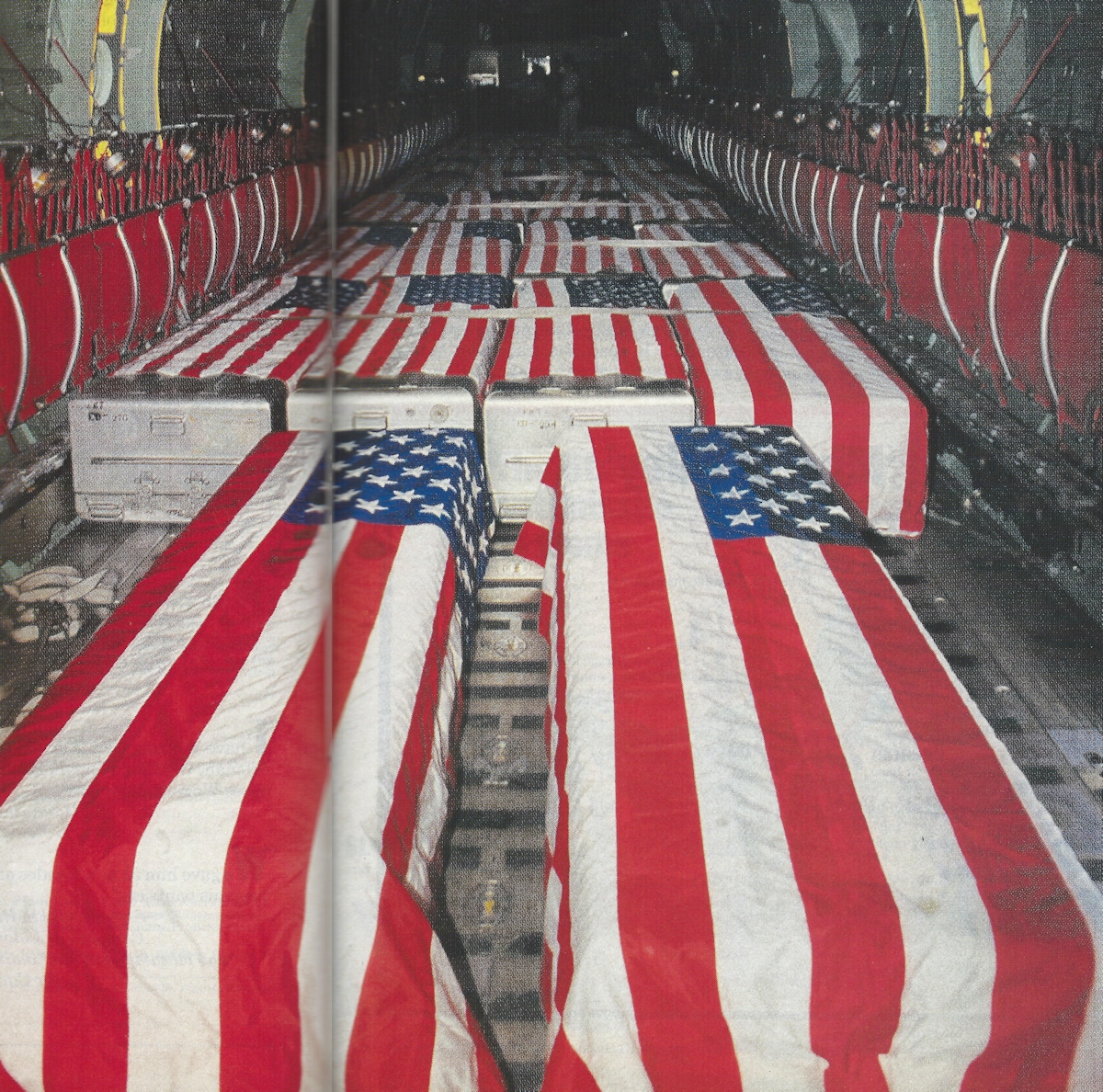
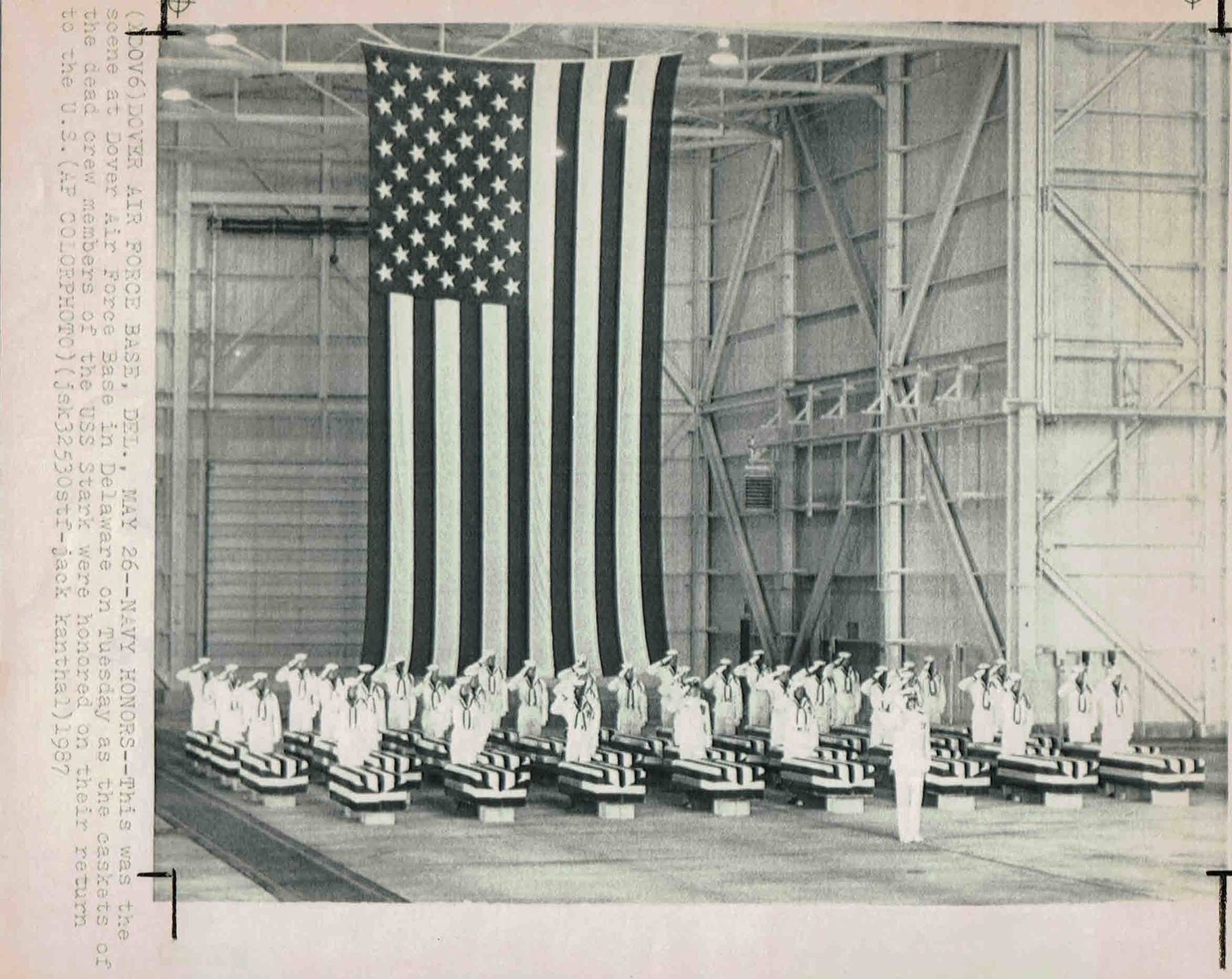
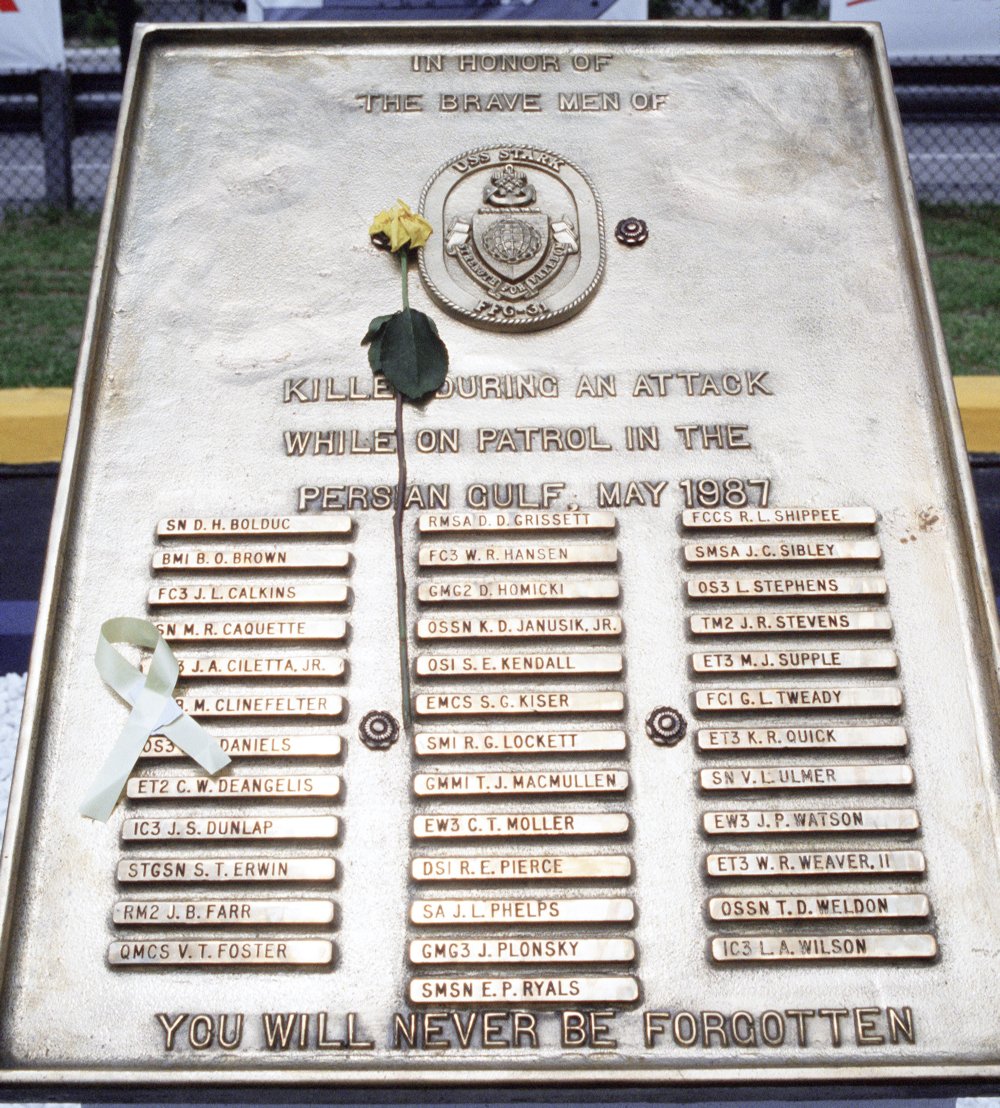
USS Waddell GMM1 Gary Mahone also showed men how to use escape gear but fell through the hole in the confusion. The last time anyone saw OSSN Terrance D. Weldon, he appeared to be wounded and in shock. Both men went into the water. GMM3 Mark Samples courageously stayed in the missile magazine for nearly 13 hours before relief. Despite consistently losing power that reduced the flow of water to a trickle, GMM3 Samples poured water onto the missiles to prevent the heat from cooking-off their fuel. The Gunner's Mate probably prevented a catastrophic explosion, but the combination of water from all the firefighting efforts resulted in the ship’s settling. The attack killed 36 sailors, plus one missing (Weldon), many of them burned in their racks while sleeping or suffocating from a lack of oxygen. In addition, the battle wounded 21 more men, two of whom suffered serious burns. Stark’s crewmen valorously saved their ship, and demonstrated their
intensive damage control training. Captain Brindel had once ordered them to move about blindfolded to simulate the fear and sensory deprivation of battle.
Vessels that aided Stark included the
USS La Salle The Iraqis claimed that the attack resulted from mistaken identity. The Mirage’s inertial navigation system normally proved reliable and they claimed that
it indicated that Stark steamed off course and further easterly than she reported, placing her within the zone when the attack occurred. The Americans,
however, claimed that the tracks that Stark, Coontz, and the AWACs provided all agreed that she operated to the west of the zone. “I know and I share,”
President Ronald W. Reagan said resolutely the next day, “the sense of concern and anger that Americans feel over yesterday’s tragedy in the Persian Gulf. The
officers and crew of the USS Stark deserve our highest admiration and appreciation.” The attack incensed many Americans, and the Sixth Fleet alerted the
USS Kitty Hawk CDR John B. Noll relieved CAPT Brindel on 22 June, and then Noll held a Captain’s Call for the entire crew. Stark tentatively completed her repairs
sufficiently to enable her to return home on 24 June, carried out sea trials the following day to verify the efficacy of the work, and returned to Bahrain to
reprovision and refuel. One hundred eleven sailors continued to man the ship, but the other survivors flew home to an early reunion with their loved ones,
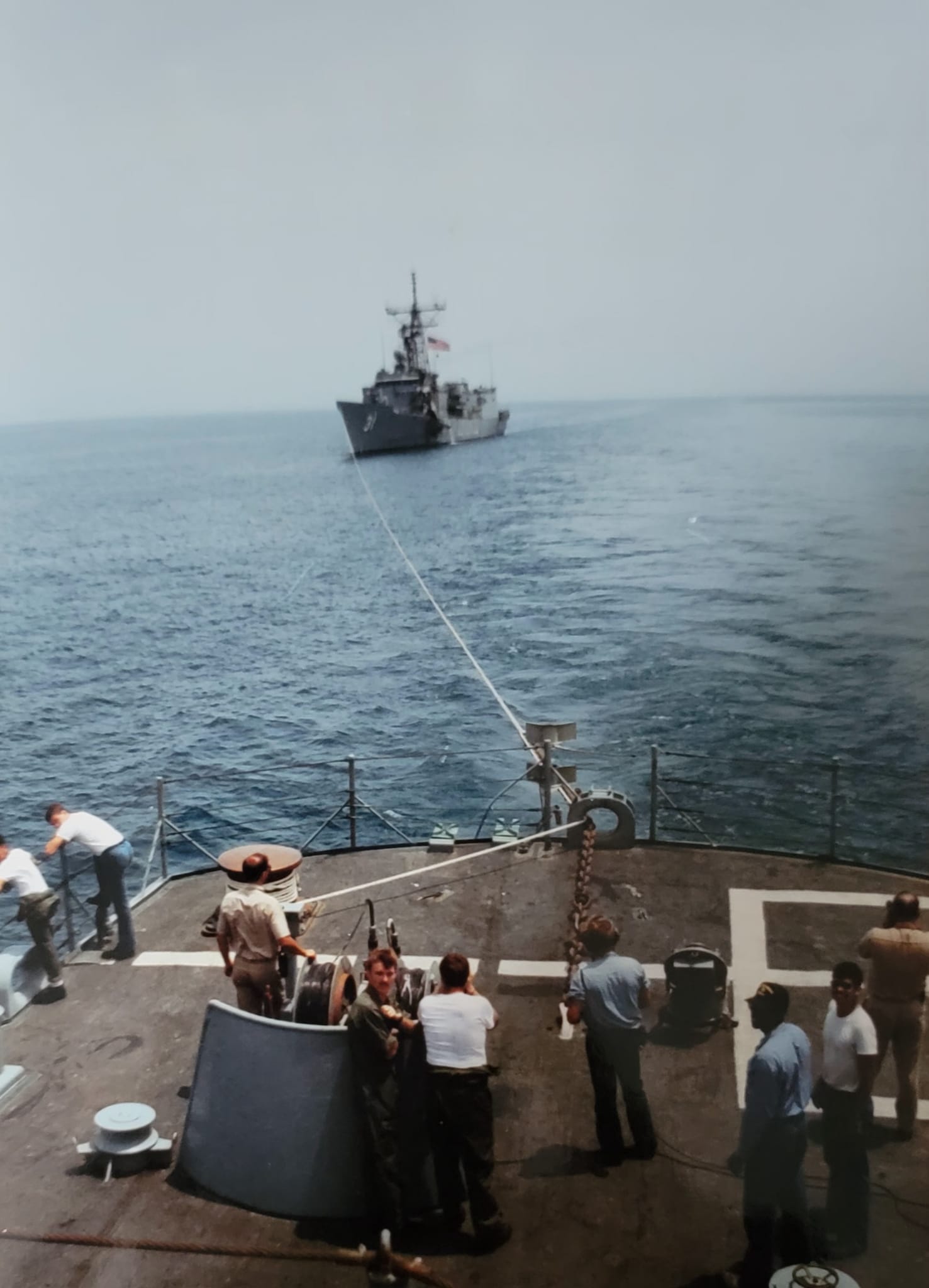
primarily because of a lack of berthing resulting from the ship’s damage. Stark anchored at Sitra on the first of the month, and on 2 July defiantly turned
her prow homeward, sailed from the Persian Gulf, and refueled at Fujairah on 4–5 July and Mina Raysut, Oman, on 9 July. The ship steamed through the
Bab-el-Mandeb and up the Red Sea, passed through the Suez Canal northbound 15–16 July, crossed the Mediterranean, replenished from Mississinewa on 17 July and
MSC-manned combat store ship
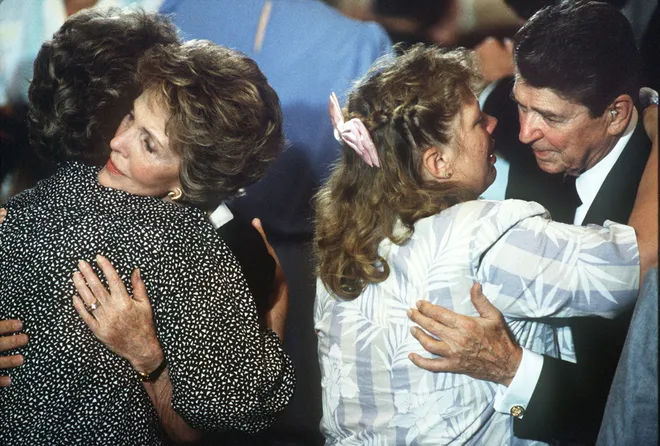
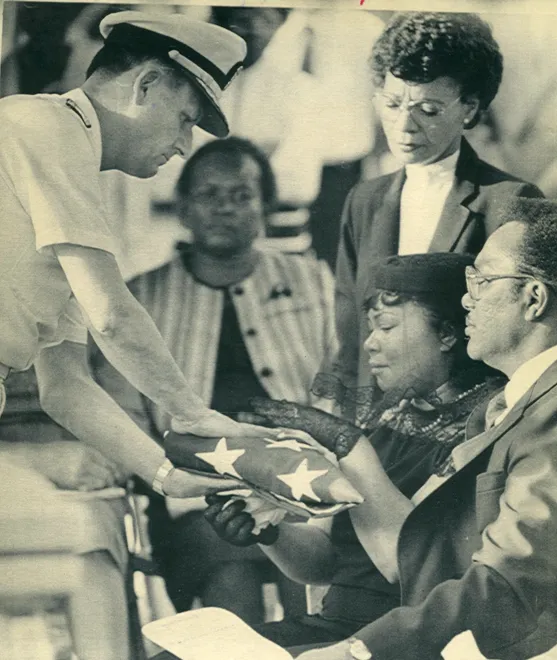
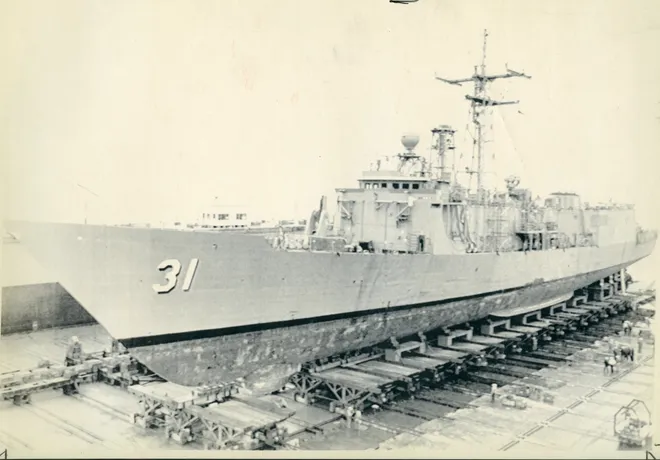
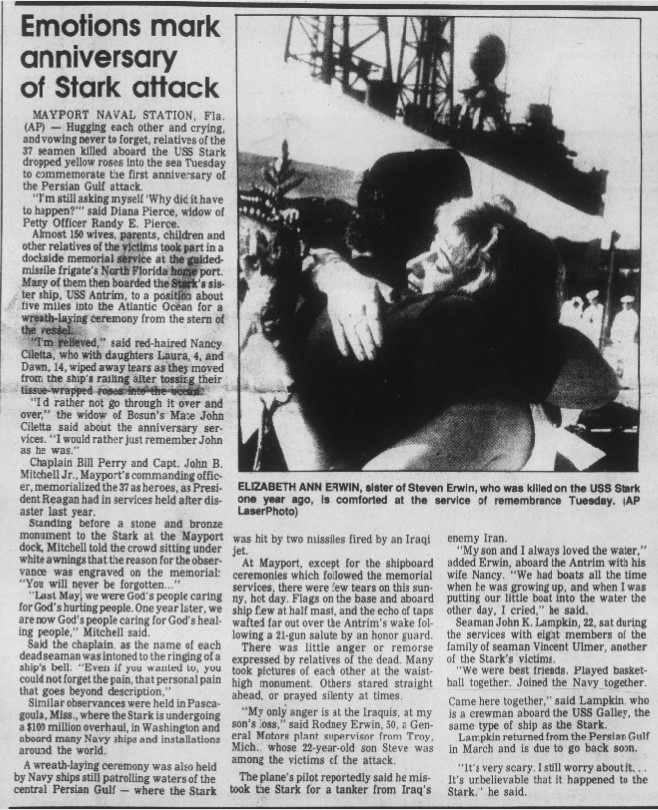
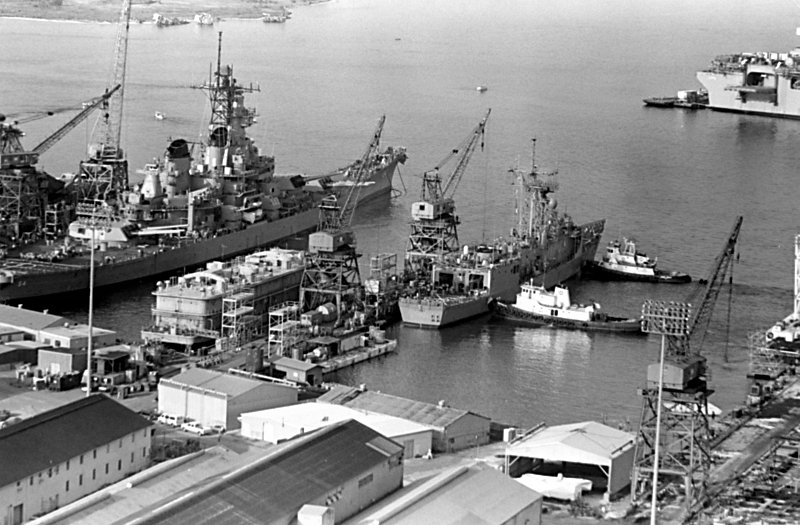
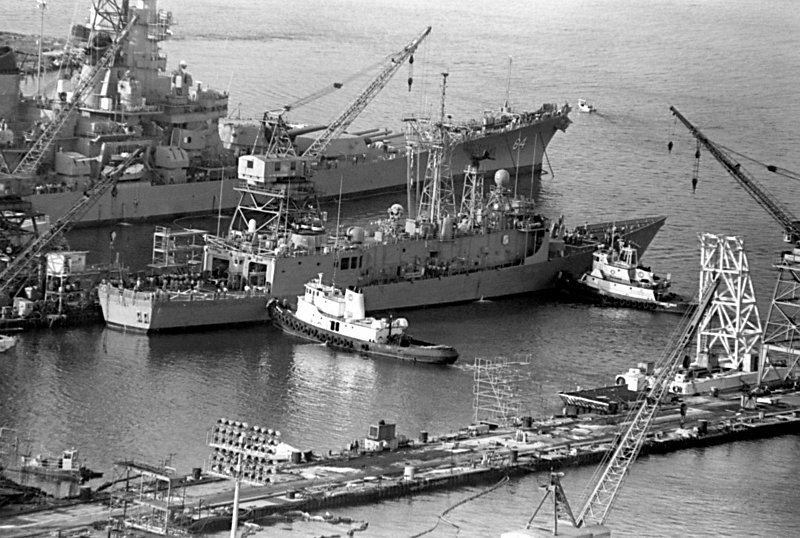
USNS Sirius President Reagan met some of the grieving family members during the memorial service on 22 May at Mayport. “They were ordinary men who did extraordinary things,” he movingly paid tribute to the ships company. On August 10, CAPT Thomas O. Gabriel, Commander DesRon 8, presented awards to men of the ships company, as well as a check to Navy Relief for the Stark Memorial Scholarship Fund. The ship accomplished limited repairs during an intermediate maintenance availability at Mayport, and then complete repairs at Ingalls Shipbuilding, East Bank, Pascagoula, MS until August 1988. The veteran warship offloaded supplies and the crew’s personal gear immediately upon arrival, and entered drydock on 16 November, where the damaged area from Frames 97 to 156, 0-2 Level down to the 2nd Deck, was removed on 23 November. 1988Vice President George H.W. Bush arrived at Ingalls Shipbuilding on 2 March 1988, and spoke with CDR Noll under Stark’s bow while she underwent the work in drydock. Stark completed a significant overhaul milestone on 20 March when she undocked in the Singing River on a 40,000 ton floating drydock, and proceeded to a berth at the company’s East Bank facility. Due to incorrect material, soft steel vice HY-80 grade steel, used for doubler plates on the hull, however, the ship returned to drydock at the West Bank facility so that the shipyard could replace the doubler plates 18–24 April. Stark then resumed her work on the East Bank. Some additional delays occurred, and insufficient progress of the main space turnover and a lack of ships company hands-on training time led the Navy to postpone the Mayport Gas Turbine Mobile Training Team’s Type III (their third visit during the overhaul) from the beginning of August to mid-month 15–19 August. On 17 May 1988, the first Memorial Service for the fallen sailors of the USS Stark was held at Naval Station Mayport. Almost 150 wives, parents, children,
and other family and friends gathered on Bravo pier for the Service. Many of the family members and some survivors of the Stark boarded the
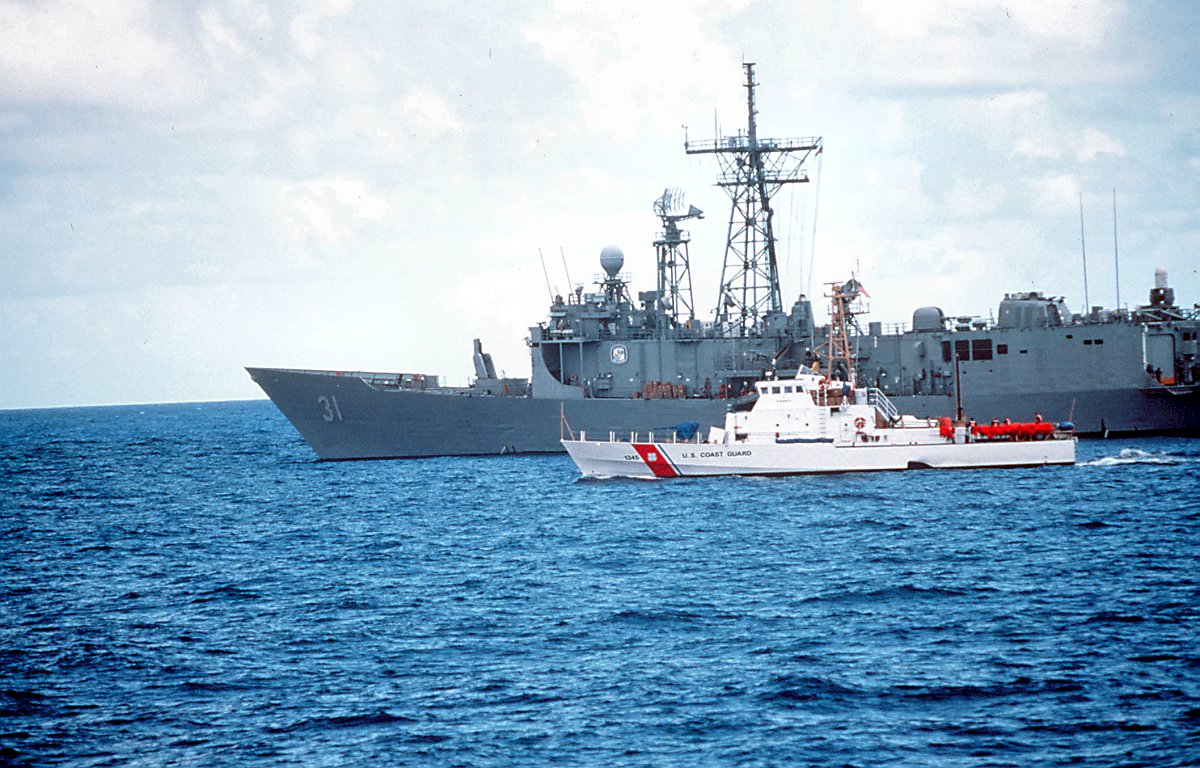
USS Antrim Following her repairs, the ship, with a Coast Guard law enforcement detachment embarked, stood down the channel from Pascagoula and returned to Mayport 31
August–1 September 1988. Stark made a brief cruise in northern waters, and carried out her first underway replenishment since the yardwork when she rendezvoused
with the
USS Merrimack 1989Stark carried out rigorous refresher training off Guantánamo Bay early in the New Year. An unforeseen equipment problem delayed the ship’s propulsion examination
board from inspecting the ship from early the following month until later in March. The frigate meanwhile stood by for contingency duties when space shuttle STS-29
Discovery launched from John F. Kennedy Space Center, FL, and returned to earth at Edwards Air Force Base, CA in March. Stark trained again at AUTEC, and then in
April trained with helos from HSL-32 and HSL-34 as they performed deck qualifications off the Virginia capes. The warship visited Port Everglades, carried out
additional training, and then stood by in preparation for space shuttle STS-30 Atlantis, the ship briefly refueled and then monitored Atlantis when she launched the
following day. Stark took part in Type Commander’s Core Training 3-89 in company with the
USS Sampson Stark, with HSL-36 Detachment 6 embarked, and in company with the
USS William V. Pratt 1990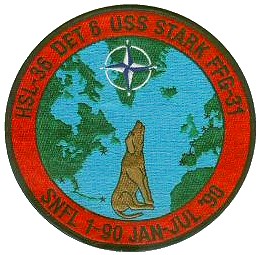
The ship, with a Seasprite LAMPS I of HSL-36 Detachment 6 embarked, and in company with Cornwall, deployed from Mayport with NATO Standing Naval Force Atlantic 12
January–11 July 1990. Stark refueled from Canadian replenishment oiler Protecteur (AOR.509) three days later, and carried out some additional pre-deployment work at NS
Roosevelt Roads, where she held a force reception breakfast on the fantail. She fired two practice RIM-156 Standard surface-to-air missiles, one of which splashed a
target drone, and completed work ups during FleetEx 1-90 in Puerto Rican waters, refueling midway through the exercise from MSC-manned
USS Neosho Following Stark’s brief Canadian visit, she set out across the Atlantic 24 March–5 April 1990, refueling from Preserver and at Punta Delgada, and then completing maintenance at Wilhelmshaven, West Germany. The ship stood out of that port for antisubmarine and gunnery exercises Dragon Hammer and Open Gate in the Atlantic and Mediterranean, refueling from West German replenishment oiler Rhön (A.1443) and British Brambleleaf (A.81). The ship marked the highlight of Open Gate by a long high speed chase of a French nuclear-powered submarine. Stark put in to Lisbon, Portugal in mid May, Santander, Spain, and Lorient, France at the end of May, in between these operations. An exercise with French submarines was cancelled, and Stark and Cornwall visited Portland, England. The British crewmen enjoyed their first visit home in six months, and some of them invited their American allies home to meet their families. Stark stood out of that harbor, refueled from Brambleleaf, and reported that she steamed “slowly and cautiously through the foggy English Channel.” The ship crossed the
North Sea and briefly visited Stavanger on 5 June, before taking part in NATO exercise Bright Horizon 1-90. Intense antisubmarine operations marked Phase I of the exercise
as Stark traversed Norwegian fjords. During the next phase she entered the Baltic Sea and battled West German and Swedish “aggressors.” Phase III finished with a 50 ship
simulated amphibious landing. After winding back through the Kattegat and Skagerrak into the North Sea, the ship hunted submarines along the Norwegian coast. Bright
Horizon 1-90 culminated with an air-sea battle off the Danish coast as British and West German aircraft attacked the NATO force, the surface squadron augmented by Norwegian
warships. Stark refueled from Brambleleaf and West German Glücksburg (A.1414). The ship renewed her Norwegian relations with a visit to Kristiansand, and then through the
end of the month took part in Dutch Fleet Week at Den Helder in the Netherlands. Guided missile destroyer
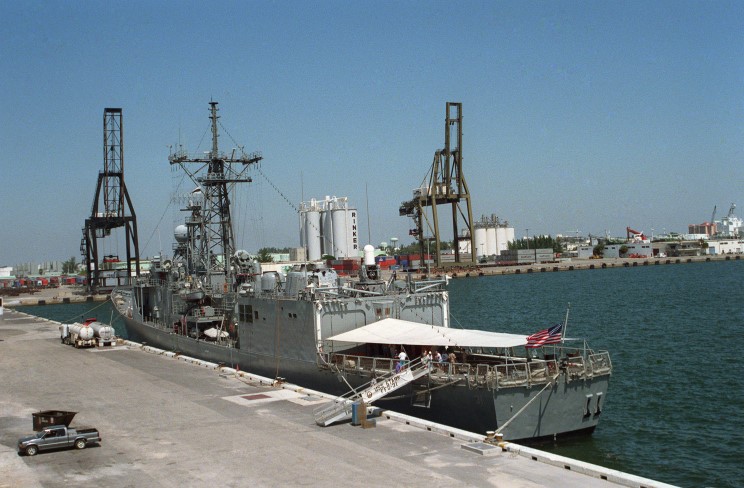
USS King 1991The Iraqis had meanwhile invaded Kuwait on 2 August 1990, and the coalition established Operations Desert Shield, Desert Storm, and Desert Sabre to protect the region, contain Iraqi aggression, and liberate the Kuwaitis. Stark’s crewmen therefore carried out the usual assortment of training exercises and maintenance with the pall of the fighting in the Middle East looming over them. The war disrupted deployment cycles and rumors circulated among her men that they would deploy early, but they nonetheless began the New Year by observing Super Bowl XXV when the ship visited Tampa Bay, FL 25–28 January 1991. The Boatswain Mate’s set up a flight deck canopy and the Mess Management Specialist’s prepared the food and refreshments for a formal reception that included a number of NFL owners and movie stars. Some of the crewmen received complimentary tickets to the game, though security precautions resulting from the war prevented the ship from hosting additional visitors. The frigate also broke the routine by celebrating Independence Day while moored at Penn’s Landing, Philadelphia, PA 3–8 July. CDR Ulrich, the commanding officer, had grown up near the city and his family and several of the other officer’s wives temporarily embarked as the ship steamed up the Delaware River. In addition to setting up the well-used flight deck canopy and feeding guests, the crew also rigged “up and over” red, white, and blue lights. Guests enjoyed the fireworks from the 02 level following the reception. Local sailor SK3 Thomas Bambara reenlisted in front of the Liberty Bell, more than 10,000 people toured the ship, her color guard participated in the honors at a baseball game between the Phillies and Cardinals at Veterans Stadium, and some of the ships company marched in the Fourth of July Parade. When the warship returned to Mayport she accomplished a variety of work, including installing a Mk 38 25 millimeter gun mount and changing out the 1A gas turbine generator. 
Stark, with a Seasprite of HSL-36 Detachment 6 again embarked, and in company with the
USS Aubrey Fitch The ship got underway and steamed for the North Frigate Patrol Station in the northern Persian Gulf. The engine of one of the embarked Kiowas failed while the helo patrolled low
over the Arabian Gulf the first night out, at 2136 on 20 September. The pilot, an experienced senior Warrant Officer, brought the Kiowa’s nose up at the last moment but the helo
crashed tail first into the water. Stark increased to flank speed and raced to the scene of the crash, while the second Kiowa searched for the two men floating within the swells.
The soldiers discovered their comrades, lowered rope ladders, and pulled the injured men out of the water and returned them to the ship. The pilot suffered back injuries, and the
co-pilot endured a broken cheek and jaw bone. The ship’s medical team stabilized the men, and they were then evacuated to an Army hospital in Saudi Arabia for further treatment.
The ship stopped briefly at Bahrain and offloaded the remaining Kiowa and the soldiers on 24 September, and then returned to sea. She utilized her Kingfisher mine detection sonar
to help MSC-manned
USNS Sioux In addition, ongoing concerns over Iraqi smuggling compelled the UN to begin multinational Maritime Interception Operations (MIOs) to enforce UN Security Council Resolutions that had been imposed against the Iraqis following their invasion of Kuwait in August 1990. Resolution 661 prohibited the export of cargo that originated in Iraq, while Resolution 665 called upon the coalition to verify compliance. The food-for-oil agreement permitted the Iraqis to sell limited amounts of oil to pay for food and medicine. The coalition consistently refined MIOs to contain brazen efforts by Iraqi criminals and on occasion, terrorists (who used lucrative drug trafficking that specialized in heroin and methamphetamines to finance terrorism). Allied ships and aircraft began to track and intercept ships that entered or left Iraqi and Iraqi-occupied Kuwaiti ports, and Stark participated in these MIOs. Following the frigate’s patrol, she accomplished voyage repairs alongside submarine tender
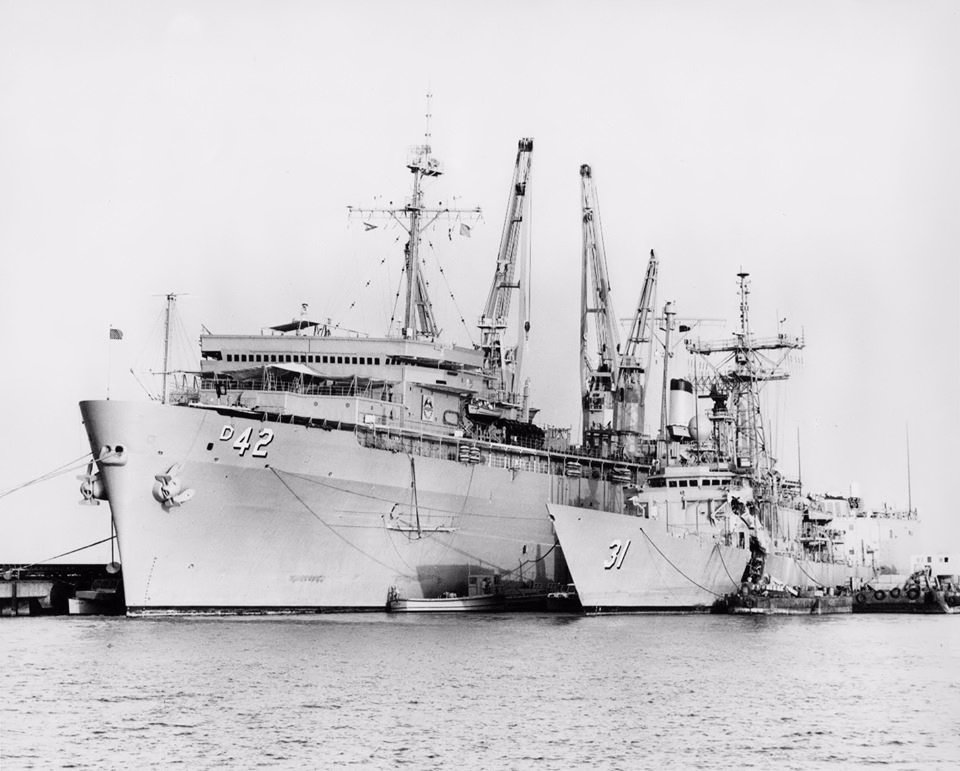
USS L.Y. Spear The ship briefly refueled at Djibouti on 25 November and then patrolled the Red Sea, where many crewmen watched football on the “on site” television on Thanksgiving. Stark exchanged
some sailors with guided missile frigate HMAS Sydney (FFG 03) on 7 December, and their Australian hosts treated their guests to a beer. The ship anchored out at Hurghada, Egypt, and
then patrolled the Red Sea. The
USS Klakring 1992Stark operated with the Sixth Fleet in the Mediterranean, and completed the deployment by visits to: Izmir, Turkey; Athens, Greece; Naples, Italy; and Barcelona, Spain. Following her return, the ship participated in a counter narcotics patrol in the Caribbean in the spring. The frigate intercepted numerous vessels suspected of smuggling drugs, and her crewmen boarded and inspected a number of them. The ship’s radar also acquired and tracked aircraft that led to several drug interceptions. In addition, Stark assisted Recovery when the merchantman lost power and began taking on water in the northern Caribbean. The ship completed a $2.9 million selected restricted availability at Mayport 30 July–20 November 1992. 1993Welcome Aboard program guide of 1993. Stark began the New Year by seizing more than 5,400 pounds of marijuana while patrolling for drug traffickers in the Caribbean. The warship trained off the east coast following her return, and the 76mm gun and CIWS successfully engaged drones. 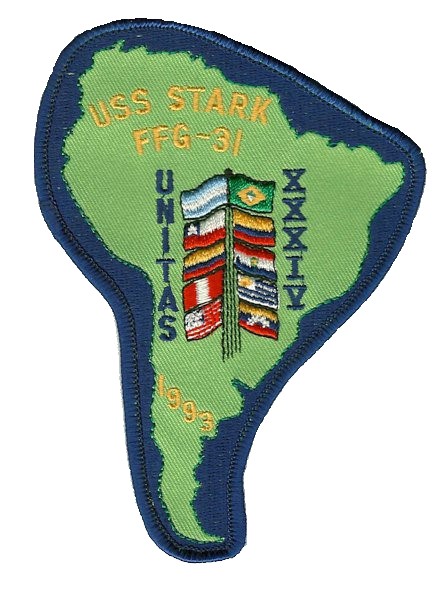
Stark was chosen to participate in UNITAS XXXIV-93 from 17 July–26 November along with the
USS Whidbey Island 1994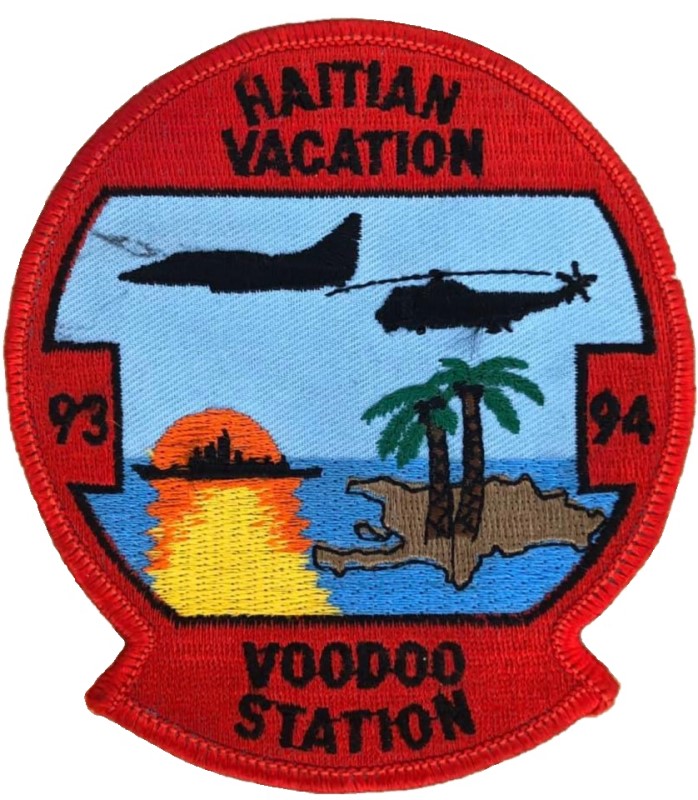
The ship again turned her prow northward when she cooperated with the Canadians, punctuating her sojourn into those colder waters by briefly stopping at Staten Island, NY. Trouble brewing to the south, however, soon turned her toward warmer waters. Following the Haitian Army’s overthrow of President Jean-Bertrand Aristide in September 1991, a succession of governments led to sectarian violence, and in May 1994 the Haitian Army imposed Supreme Court Justice Emile Jonassaint as the provisional president. Tens of thousands of people fled the country to escape the turmoil, and the US initiated Operations Able Manner to interdict migrants attempting to cross the Windward Passage to the United States, and Able Vigil to stop those crossing the Florida Straits 15 January 1993–26 November 1994. Law and order continued to collapse in Haiti and the UN authorized force to restore order. The US initiated Operations Support Democracy and Uphold/Restore Democracy—Uphold Democracy for a peaceful entry into Haiti, and Restore Democracy in the event of resistance. Stark took part in Support Democracy on three occasions. The Haitians agreed to allow the Americans to land peacefully, and on 31 March 1995 the US transferred peacekeeping functions to international forces. During the first patrol, the ship also took part in Mayfly 94, an exercise that evoked strong feelings amongst some of her crewmen because a German ship fired a practice Exocet at Stark, but the frigate shot it down with a Standard. The ship visited Veracruz, Mexico, in between these patrols, and marked the starting line for the final leg of the Whitbread Round the World Race, a competitive yacht circumnavigation, during a visit to Ft. Lauderdale, FL. Stark intercepted and the sailors of her Compliance Team boarded and inspected more than 40 vessels for UN designated contraband during Support Democracy. She escorted three uncooperative vessels to Guantánamo Bay, where the authorities arrested the mariners and confiscated their illicit cargoes. The ship also controlled Sikorsky SH-3 Sea Kings and Army Kiowas during these operations. Stark rescued 265 people from 23 boats, and at one point counted 706 refugees from her own and other rescues packed on board, during an Able Vigil patrol. Additionally, she took 12 Coast Guard vessels alongside and received and processed 1,503 Cuban asylum seekers. 1995The ship completed a cycle of training exercises and maintenance work, alternating her times at sea with a visit to Key West, FL. In addition, she embarked members of the Daughters of the American Revolution, the Sons and Daughters of the War of 1812, and some dependents and special guests and steamed up the St. John’s River to Jacksonville Landing, FL, to commemorate the 50th anniversary of World War II. The World War II Commemorative Committee presented Stark with a commemorative flag while at Jacksonville, and the ship became an official member of that community during the ceremony. While taking part in a CompTuEx off the east coast, the ship conducted 101 flight hours with USA Kiowas. 
She then deployed in company with the
USS Vela Gulf 1996-1997Stark had her sonar dome reworked and two diesel generators, fuel and storage tanks, and ventilation ducting overhauled during a drydock selected restricted availability at Detyens
Shipyards, Inc, Wando, SC. Following the ship’s return to Mayport, she emergency sortied to escape Hurricane Fran, heading south toward the lee of the Bahamas and Florida Straits. The frigate
returned to the Caribbean for CompTuEx 97-2 from 13 November–14 December, and the training varied from scripted familiarization runs with submarines to search and detection scenarios involving
several coordinated simulated torpedo attacks against the submarines. In addition, Stark performed plane guard for the
USS John F. Kennedy 1998The frigate celebrated New Year’s 1998 at nearby Jacksonville, and trained during the winter and spring. She took part in IndEx 98-2, an independent steaming and weapons exercise in the
Caribbean, during which she visited San Juan, PR and St. Maarten. Stark then deployed again to NATO Standing Naval Force Atlantic 22 June–19 December 1998. The ship joined the force at Boston,
MA, and then began her operations in earnest with a series of training exercises punctuated with occasional port visits. Stark celebrated Independence Day at New York City, and following some
additional training, turned her prow southward and visited Nassau in the Bahamas, Cartagena, Columbia, Roosevelt Roads, and then back to Mayport to perform voyage upkeep and repairs in August.
The ship emergency sortied two days earlier than originally scheduled in order to avoid Hurricane Bonnie. She then crossed the Atlantic to work with her European allies as part of that force,
relieved the
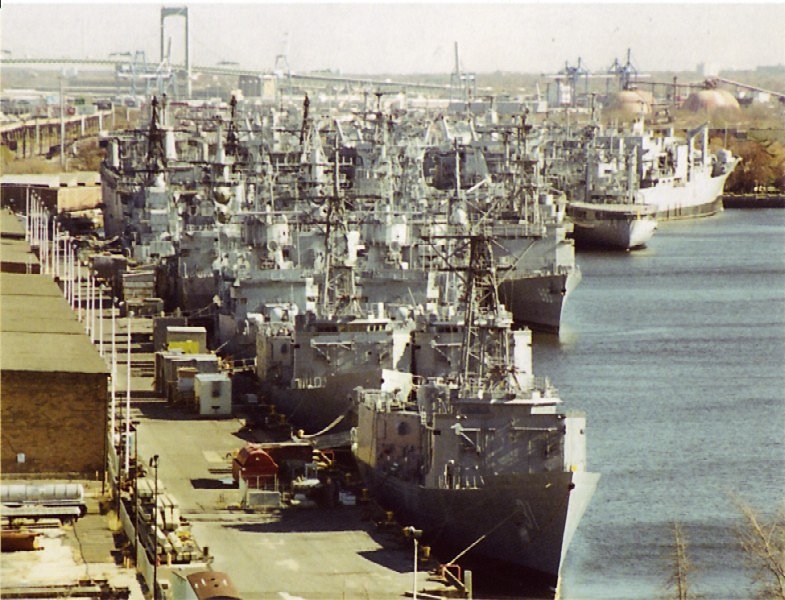
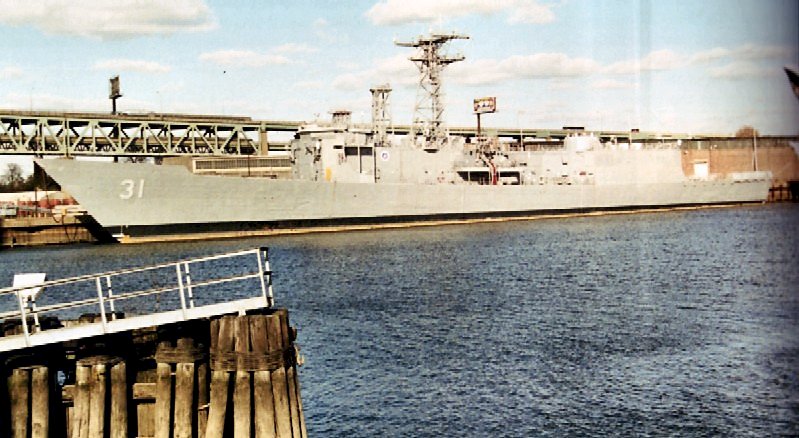
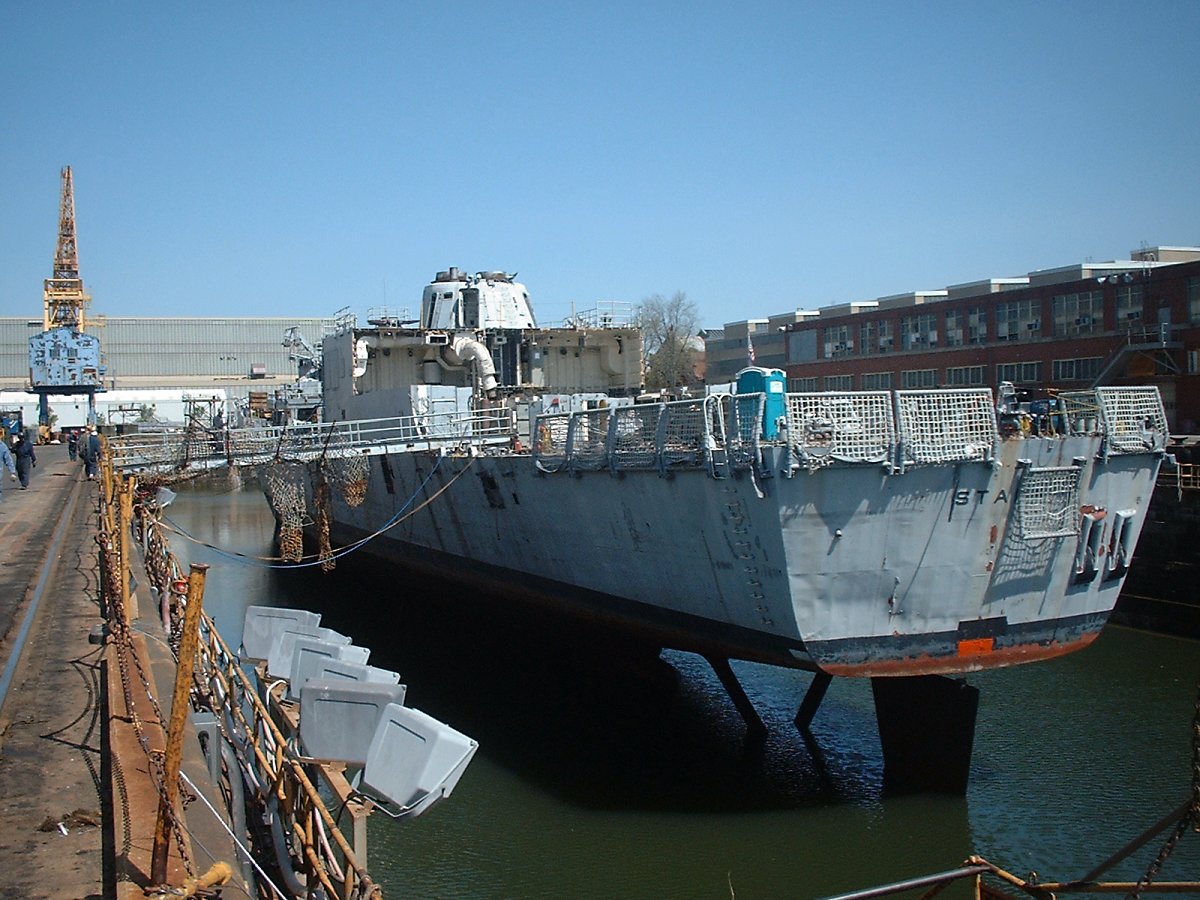
USS Robert G. Bradley 1999Stark offloaded her ordnance for the final time at Yorktown on 28 January 1999, and was stricken and decommissioned on 7 May 1999 at Mayport. At 0928 on 13 October 2005, the Naval Inactive Ship Maintenance Facility at Philadelphia transferred the veteran warship to nearby Metro Marine Corp, for disposal. The Naval Vessel Register reported her scrapped on 21 June 2006. |

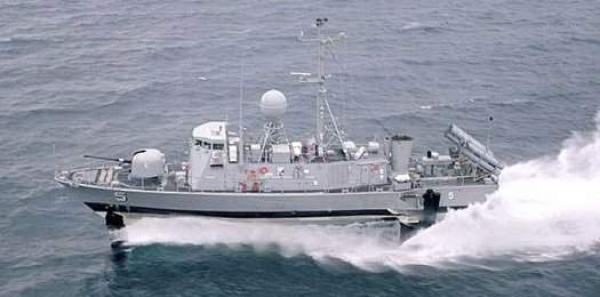 (PHM-5)
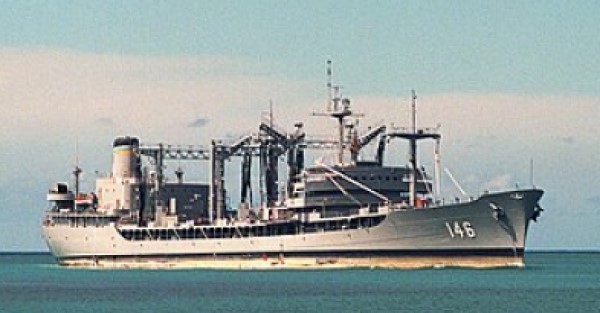 (T-AO-146)
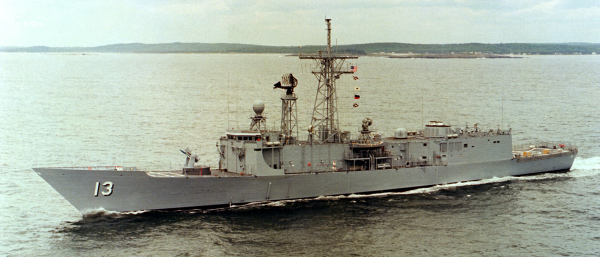 (FFG-13)
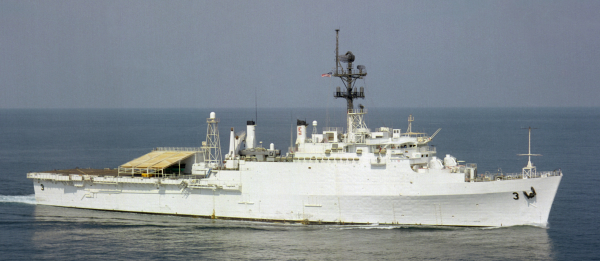 (AGF-3)
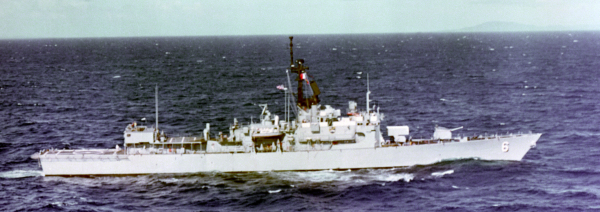 (FFG-6)
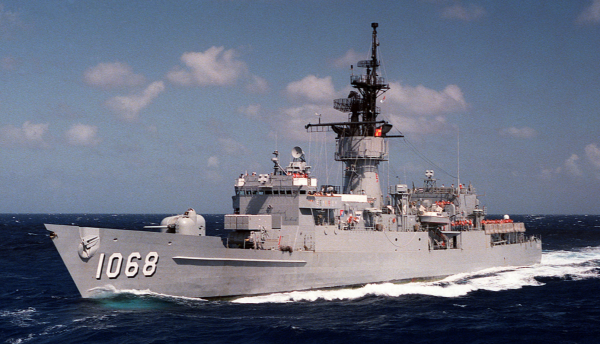 (FF-1068)
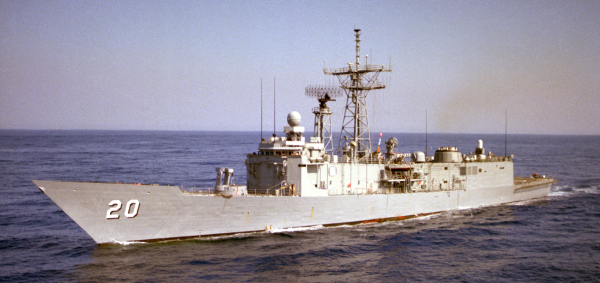 (FFG-20)
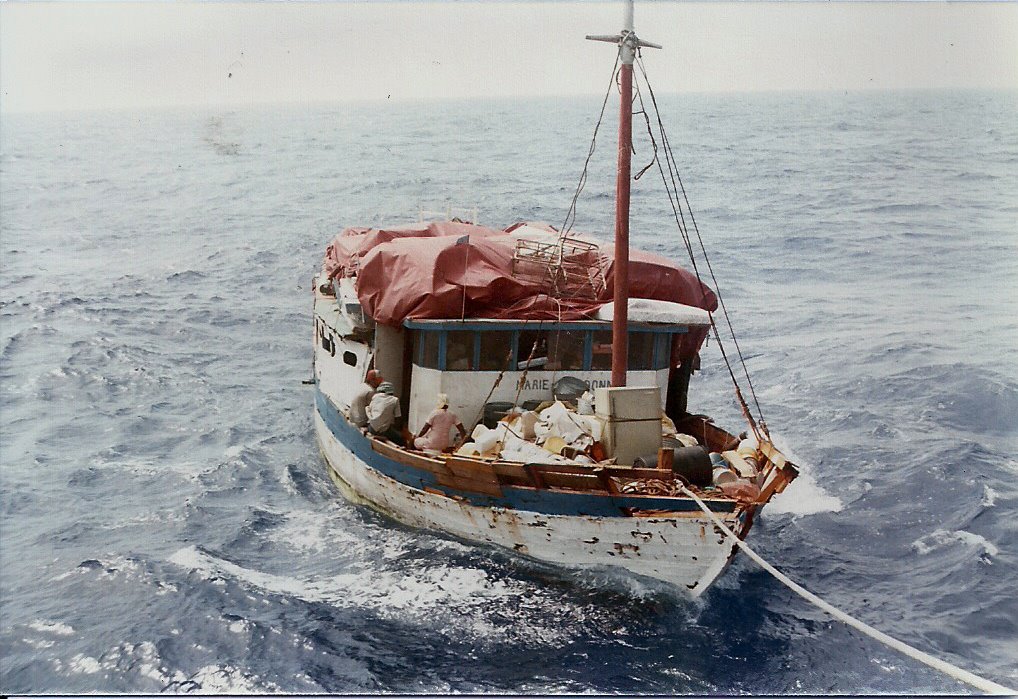 While en route toward those waters the ship’s lookouts sighted motor vessel Marie Meudonne
in distress. Stark took the vessel in tow and began to dewater the sinking ship using portable dewatering equipment. The frigate rescued all 22 people from
Marie Meudonne and transferred them to Coast Guard cutter
USCGC Unimak
While en route toward those waters the ship’s lookouts sighted motor vessel Marie Meudonne
in distress. Stark took the vessel in tow and began to dewater the sinking ship using portable dewatering equipment. The frigate rescued all 22 people from
Marie Meudonne and transferred them to Coast Guard cutter
USCGC Unimak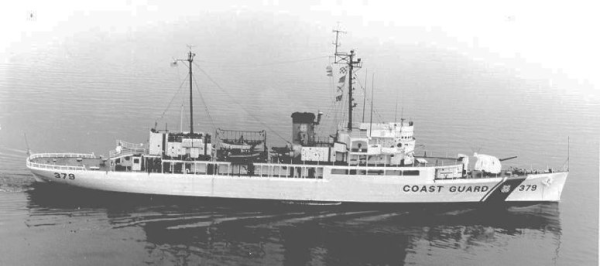 (WHEC-379)
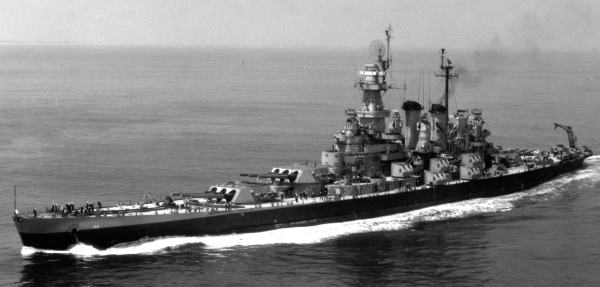 (BB-55)
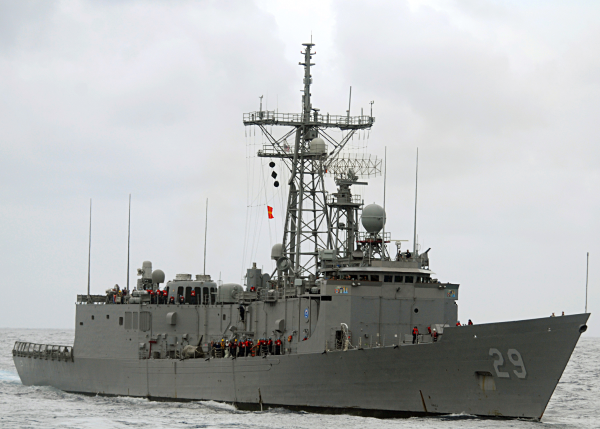 (FFG-29)
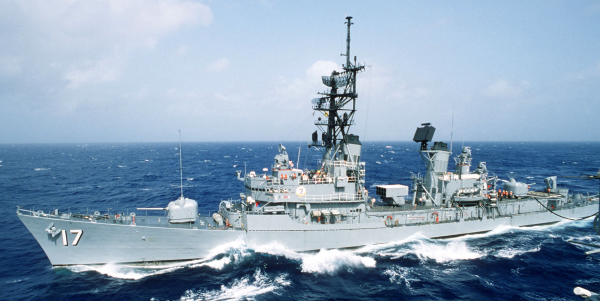 (DDG-17)
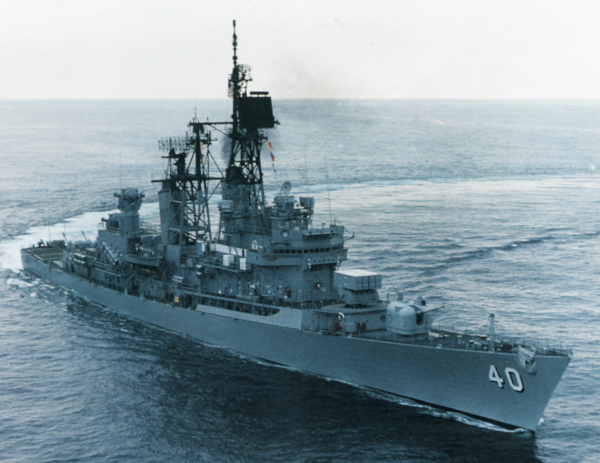 (DDG-40)
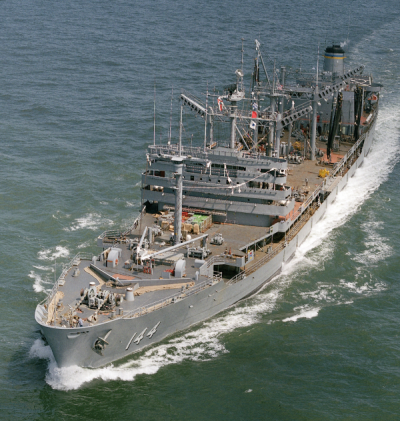 (T-AO-144)
 (AO-6)
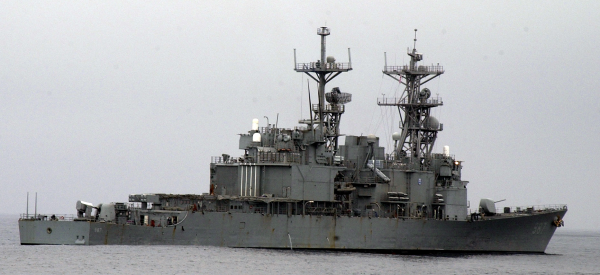 (DD-987)
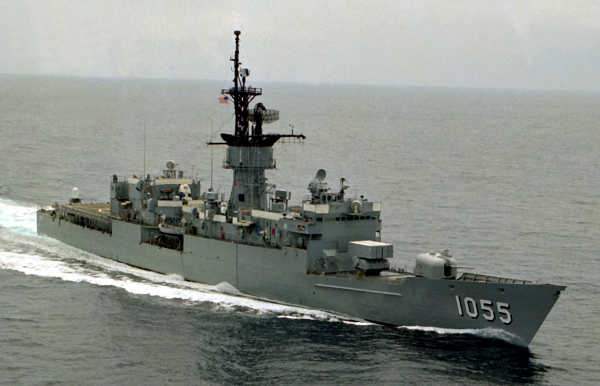 (FF-1055)
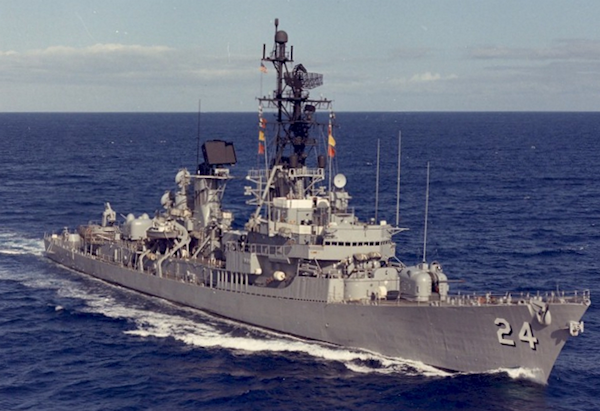 (DDG-24)
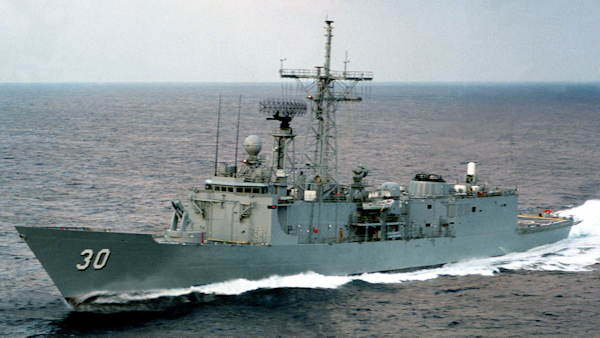 (FFG-30)
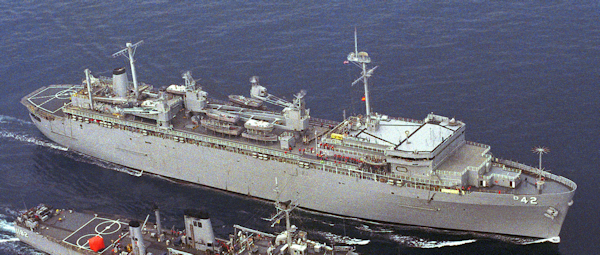 (AD-42)
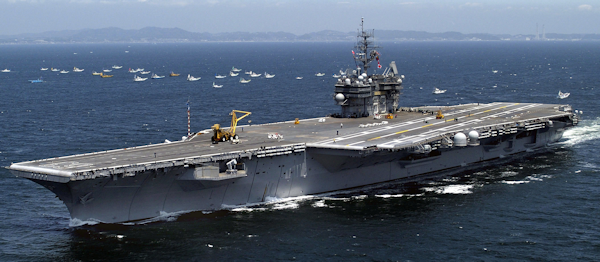 (CV-63)
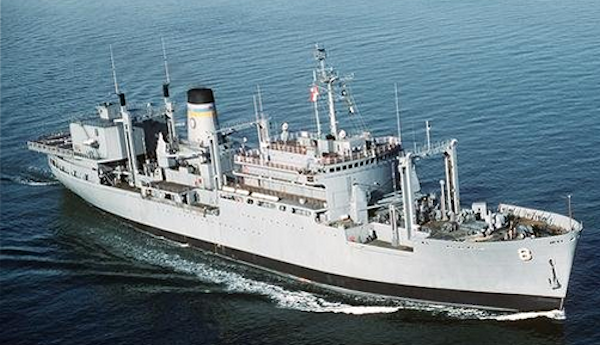 (T-AFS 8)
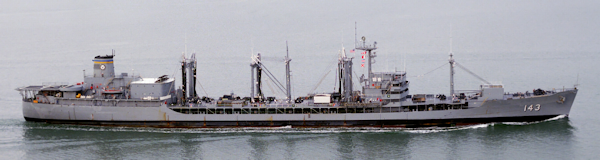 (T-AO-143)
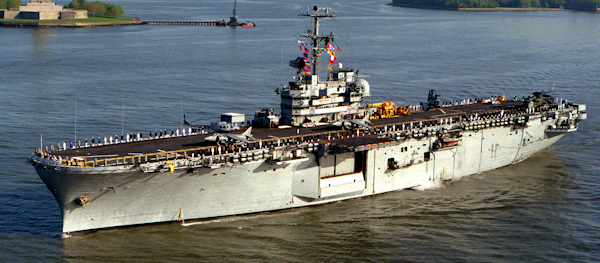 (LPH-7)
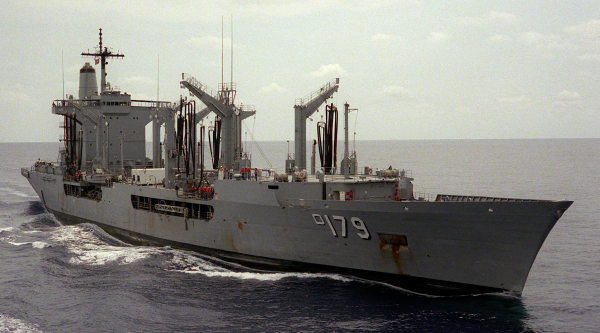 (AO-179)
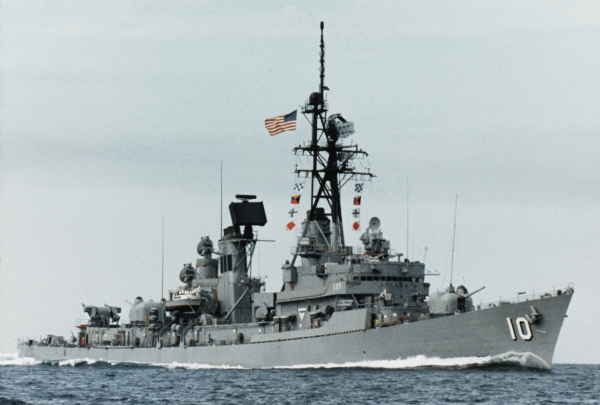 (DDG-10)
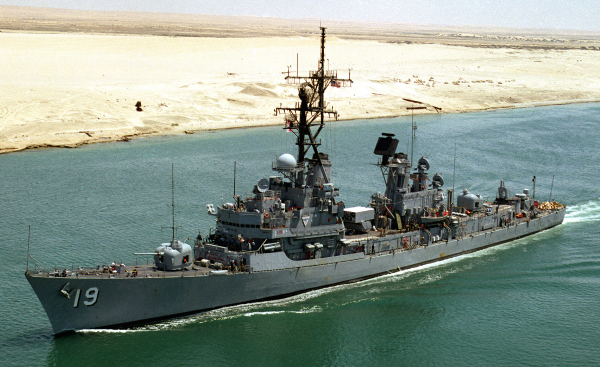 (DDG-19)
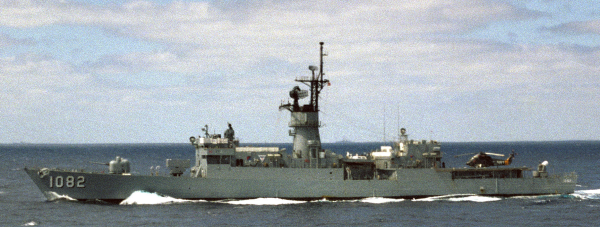 (FF-1082)
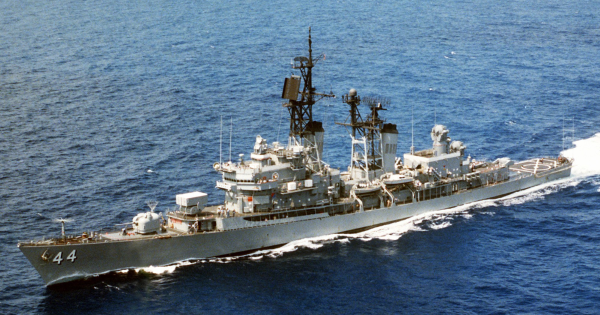 (DDG-44)
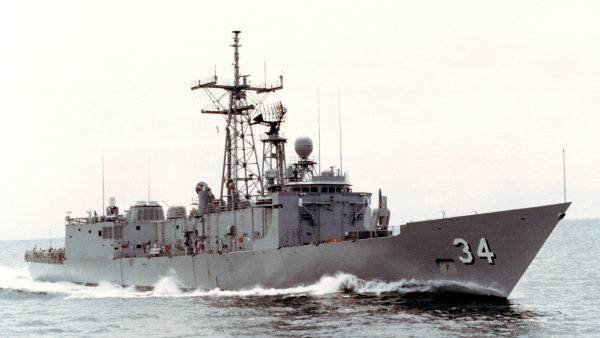 (FFG-34)
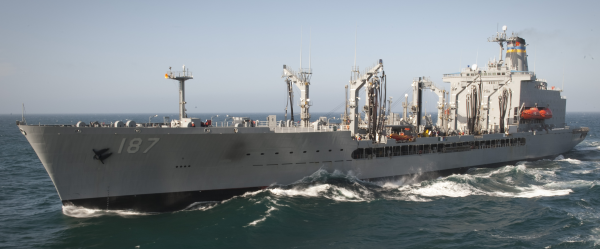 (T-AO-187)
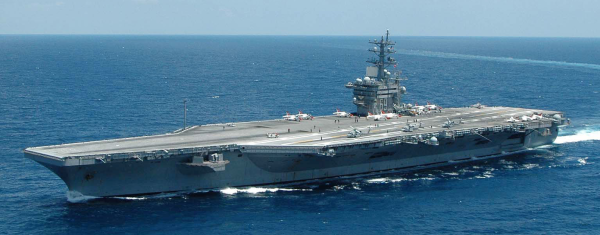 (CVN-69)
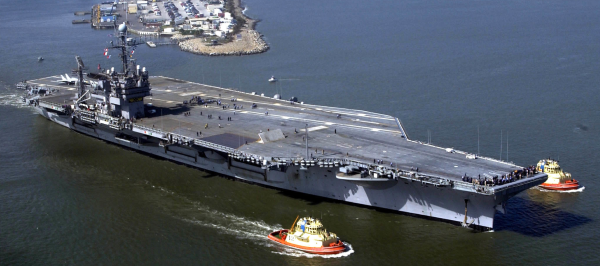 (CV-67)
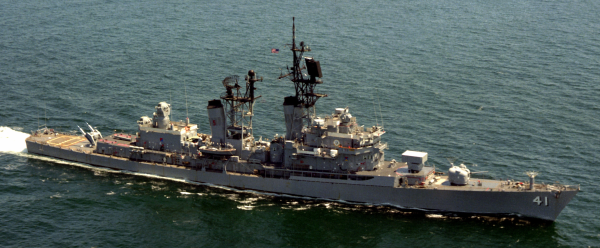 (DDG-41)
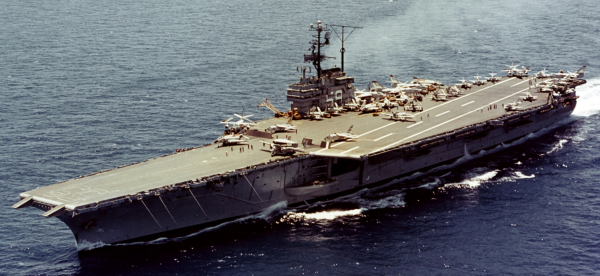 (CV-59)
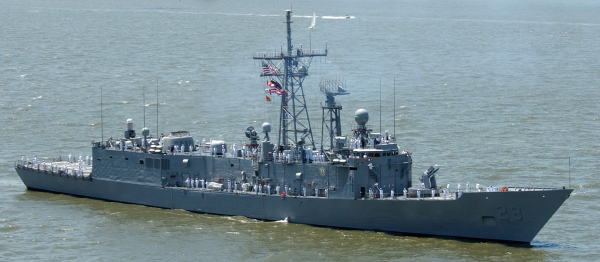 (FFG-28)
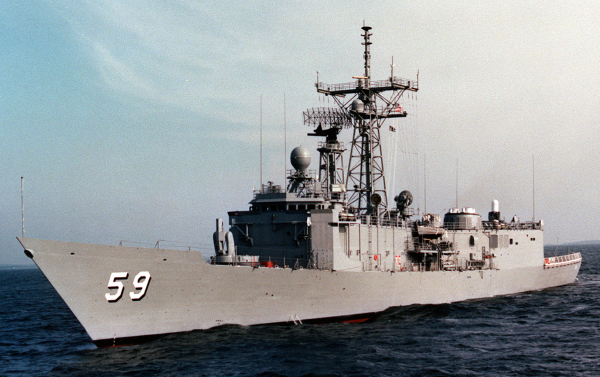 (FFG-59)
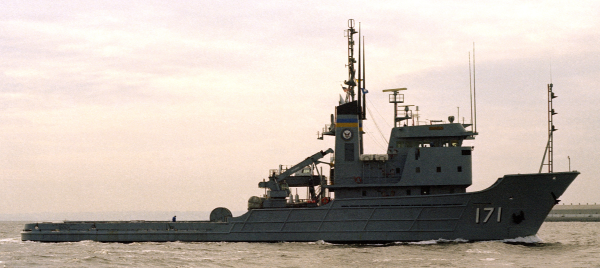 (T-ATF-171)
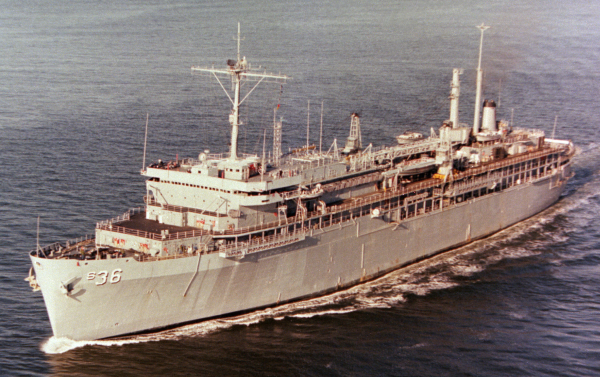 (AS-36)
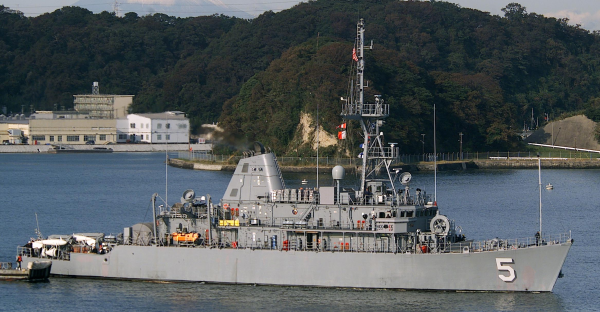 (MCM-5)
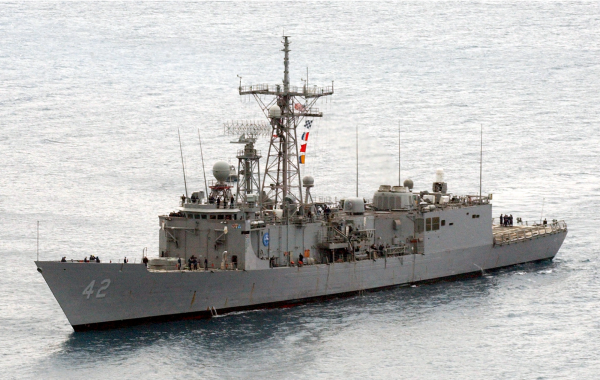 (FFG-42)
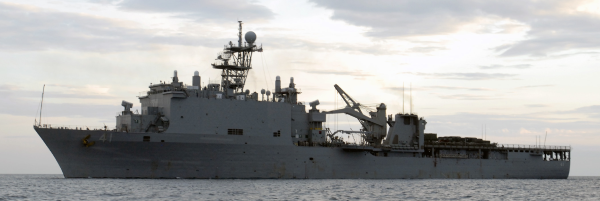 LSD-41
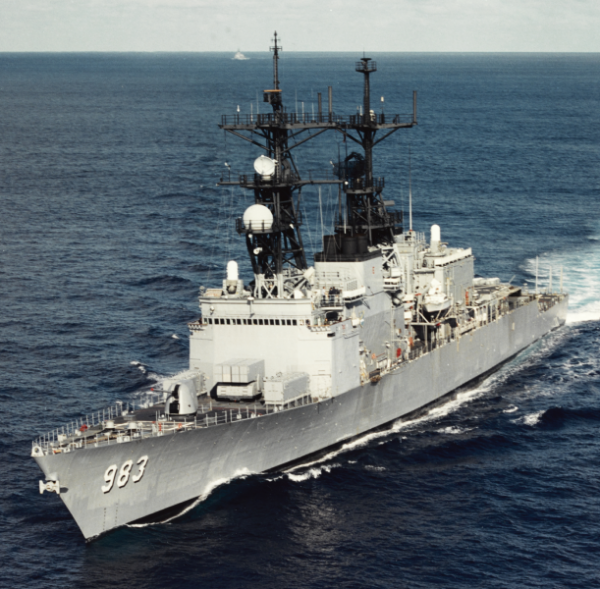 DD-983
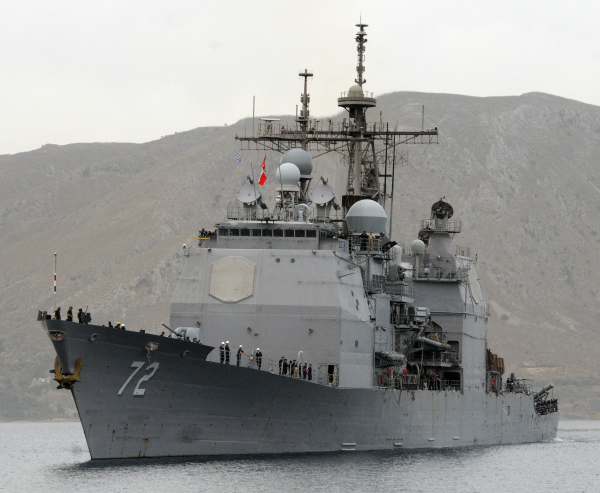 (CG-72)
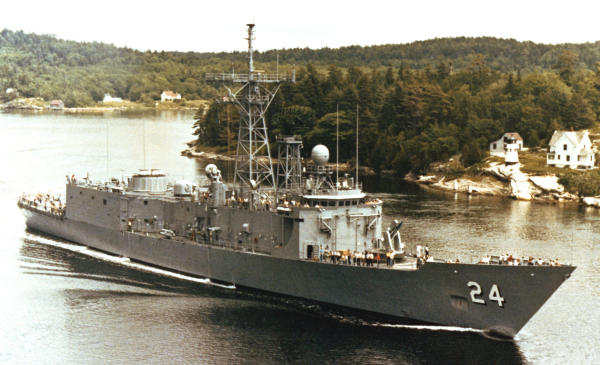 (FFG-24)
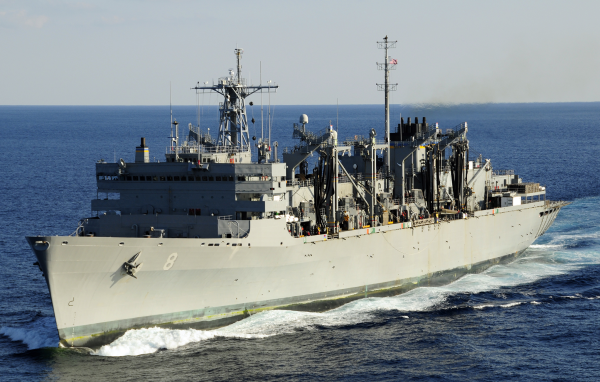 (AOE-8)
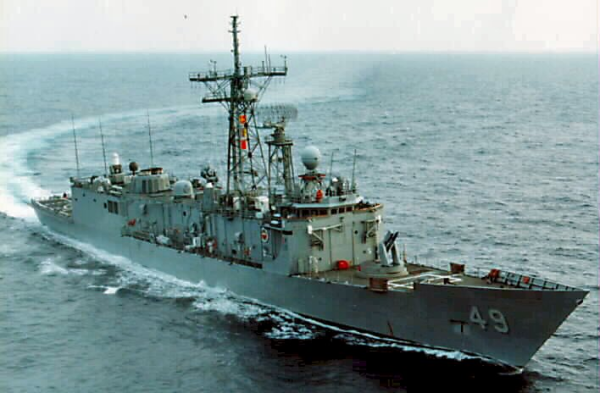 (FFG-49)
